ETL Data Integration: A 2026 Guide for Cloud Data Warehouses

19 minutes to read
Get free consultation


Are your data pipelines brittle? Do they break at the slightest touch, leaving your team scrambling to fix them while business stakeholders complain about stale reports? You’re not alone. For years, organizations have been wrestling with legacy ETL (Extract, Transform, Load) processes that are ill-suited for the dynamic, high-volume world of cloud data. The center of gravity for data has decisively shifted to the cloud, and this new reality demands a new approach to data integration.

At Stellans, we’ve helped dozens of companies migrate from brittle ETL jobs to a modern ELT framework, witnessing firsthand the transformation it brings. It’s not just about swapping out old tech for new; it’s about building a reliable, scalable, and maintainable data foundation that fuels growth. This guide cuts through the vendor-speak to offer a practical framework for success. We will explore the critical ETL vs. ELT debate, compare the leading tools that define the modern data stack, and share a playbook for avoiding the costly mistakes we’ve seen cripple data initiatives.

The Great Debate: Why ELT is Winning in the Cloud

For decades, ETL was the undisputed champion of data integration. The high cost of on-premises data warehouse storage and compute meant that data had to be meticulously cleaned, shaped, and aggregated before loading. But the architectural constraints that made ETL a necessity have been obliterated by the cloud.

A Quick Refresher: What is Traditional ETL?

Traditional ETL is a linear, three-step process:

The primary limitation of this model in the cloud era is its rigidity and the “transformation bottleneck.” Scaling the transformation server is expensive and complex, and any change to the business logic requires significant re-engineering, slowing the delivery of insights.

The Modern Paradigm: Extract, Load, Transform (ELT)

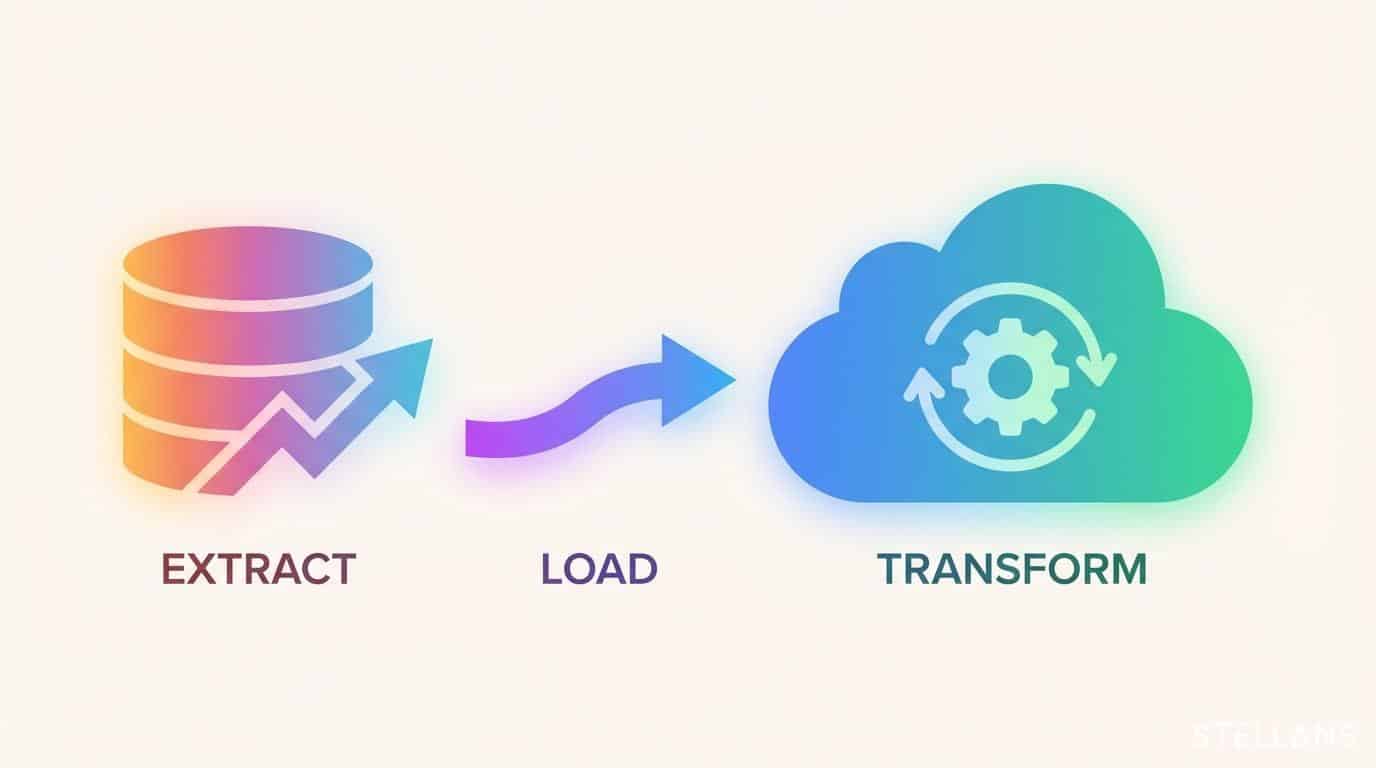
The advent of powerful and cost-effective cloud data warehouses like Snowflake, Google BigQuery, and Amazon Redshift turned the old model on its head. These platforms separate storage from compute, allowing for near-infinite scalability on demand. This architectural shift gave rise to ELT.

The ELT workflow is simple yet revolutionary:

This is a game-changer. By loading raw data first, you create a “single source of truth” that can be repurposed for countless use cases without having to re-ingest it. Transformations become flexible SQL queries (supercharged by tools like dbt) that can be easily modified, tested, and version-controlled. The benefits are clear: unparalleled flexibility, faster time to insights, and a future-proof foundation where all data is available for exploration.

The ETL vs. ELT Decision Framework

While ELT is the default choice for most modern cloud use cases, ETL still has a place. This framework helps you decide which pattern best fits your needs.

Criteria Traditional ETL Modern ELT
Primary Use Case Small-scale datasets, strict compliance needs where PII cannot enter the warehouse untransformed, and legacy systems. Big data analytics, business intelligence, machine learning, and data science on cloud data warehouses.
Data Volume & Complexity Best for smaller, structured datasets. Struggles with high volume and semi-structured data (JSON, XML). Built for massive volumes and a wide variety of data types. Easily handles complex, nested data.
Data Freshness Requirements Slower, batch-oriented. Data can be hours or even days old. Difficult to achieve in real-time. Enables near real-time data ingestion. Transformations can be run on a frequent schedule for fresher insights.
Tools & Skills Required Requires specialized ETL developers and often proprietary, GUI-based tools (e.g., Informatica, SSIS). Leverages SQL, Python, and open standards. Empowers Analytics Engineers with tools like Fivetran, Airbyte, and dbt.
Cost Structure High upfront licensing and hardware costs for transformation servers. Predictable, but inflexible. Pay-as-you-go model for warehouse compute. Can be more cost-effective if managed well; it can be expensive if not optimized.
Winner for the Cloud Niche applications. The clear winner for scalability and flexibility.

The verdict: For any organization building on a cloud data warehouse, the conversation starts with ELT. It is the new standard for building a scalable and agile data platform.

The Modern Data Stack: A Comparison of Leading Integration Tools

Adopting an ELT paradigm requires a new set of tools designed for the cloud. This collection of technologies is often referred to as the “modern data stack,” and it typically consists of a tool for ingestion (the “EL”) and a tool for transformation (the “T”).

For Ingestion (E-L): Fivetran vs. Airbyte

The “Extract” and “Load” steps are the foundation of your pipeline. Your goal is to reliably and efficiently move data from hundreds of potential sources into your warehouse with minimal engineering overhead. Two tools dominate this space: Fivetran and Airbyte.

Choosing between them often comes down to a build vs. buy philosophy, budget, and the specific needs of your team.

Feature Fivetran Airbyte
Connector Count 500+ pre-built, enterprise-grade connectors. 350+ and growing. An open-source model allows for custom connector development.
Pricing Model Consumption-based, priced on “Monthly Active Rows” (MAR). Can be expensive at high volumes. Open-source is free (you pay for hosting). Airbyte Cloud has a credit-based system. Generally, more cost-effective.
Deployment Fully managed SaaS. No infrastructure to maintain. Managed SaaS (“Airbyte Cloud”) or self-hosted (on Kubernetes, VMs, etc.). Self-hosting requires maintenance.
Support 24/7 enterprise-grade support is included with the service. Community support for open-source. Paid support tiers are available for Airbyte Cloud and Enterprise editions.
Ideal Use Case Teams that want a “set it and forget it” solution and prioritize reliability and ease of use over cost. Cost-conscious teams, startups, and engineering teams that require high customizability or have unique sources.

For Transformation (T): The Role of DBT

Once your raw data is sitting in your warehouse, it’s time for the “T”: transformation. This is where you clean, model, and apply business logic to turn raw data into valuable assets like customer dimension tables or monthly revenue reports.

The undisputed king of the modern transformation world is DBT (data build tool). DBT has done for analytics engineering what Git did for software engineering. It allows teams to build, test, document, and deploy data transformation workflows using simple SQL.

Key features that make dbt essential for the “T” in ELT include:

Here’s an example of a simple DBT model (models/staging/stg_orders.sql) that cleans up a raw orders table:

select
    id as order_id,
    user_id as customer_id,
    order_date,
    status as order_status

from raw.jaffle_shop.orders
And a data quality test (models/staging/schema.yml) to ensure every order has a valid status:

version: 2

models:
  - name: stg_orders
    columns:
      - name: order_status
        tests:
          - not_null
          - accepted_values:
              values: ['placed', 'shipped', 'completed', 'return_pending', 'returned']

By combining an ingestion tool like Fivetran or Airbyte with dbt for transformations, you create a robust, modular, and scalable ELT pipeline that aligns with modern engineering principles.

7 Common ETL/ELT Anti-Patterns to Avoid

Building a modern data stack is one thing; using it correctly is another. In our experience, avoiding common mistakes is just as critical as following best practices. Here are the top anti-patterns we see teams fall into, and how you can avoid them.

Anti-Pattern 1: Full Reloads Everywhere

The “full reload” is the brute-force approach: deleting all data in a destination table and re-ingesting the entire dataset from the source.

Anti-Pattern 2: Over-Transforming Before Loading

This is a hangover from the traditional ETL world, where teams try to perfect the data before it even lands in the warehouse.

Anti-Pattern 3: No Pipeline Monitoring or Observability

You run your pipeline, the light turns green, and you assume the data is fresh and accurate.

Anti-Pattern 4: Ignoring Data Quality and Testing

Poor data quality is the silent killer of data projects. If your business users can’t trust the numbers, your entire data platform is worthless.

Anti-Pattern 5: Hardcoding and Lack of Version Control

Your pipeline logic lives in an analyst’s local folder, or connection strings with passwords are hardcoded directly into scripts.

Anti-Pattern 6: Creating Monolithic, Interdependent Pipelines

You have one giant, end-to-end script that handles ingestion and transformation for dozens of tables. If one small part fails, the entire house of cards comes tumbling down.

Anti-Pattern 7: Neglecting Security and Compliance

You get the data flowing, but you forget to lock it down. Sensitive customer data is accessible to everyone in the company.

Modern Best Practices for Scalable & Reliable Pipelines

Avoiding anti-patterns is a great start. To build a truly world-class data integration system, you should proactively embrace these modern best practices. They reframed the solutions above into an actionable checklist for success.

Embrace Incremental Loading with CDC

Stop paying to move the same data over and over. For your most critical and high-volume sources, use tools that support log-based Change Data Capture. This is the gold standard for efficient, low-impact data replication and is essential for achieving near-real-time data freshness.

Adopt a Layered “Marts” Architecture in dbt

A well-structured dbt project is the key to long-term maintainability. Don’t just dump transformations into one folder. We recommend a layered approach:

Implement Automated Data Quality Testing

Integrate data quality tests directly into your pipeline execution schedule. With dbt, you can run tests before or after a model is built. A common pattern is to run dbt build, which will build your models and immediately run any associated tests. If a test fails, the pipeline run fails, preventing bad data from ever reaching your end-users.

Use CI/CD to Automate Deployment and Testing

Your data transformation code should go through the same rigorous deployment process as your application code. Implement a CI/CD (Continuous Integration/Continuous Deployment) workflow using a tool like GitHub Actions or GitLab CI. A typical workflow for a pull request might be:

This practice, detailed in a TDWI report on the seamless migration of ETL, is critical for ensuring that new changes don’t break existing data pipelines, models, or downstream analytics workflows.

Prioritize Data Observability and Alerting

Don’t wait for users to report problems. Invest in data observability. This could be as simple as configuring dbt’s source freshness command to alert you when a source hasn’t been updated, or as advanced as implementing a dedicated data observability platform. The goal is the same: your data team should be the first to know when something is wrong.

Conclusion: Build Your Data Foundation for the Future

The shift from on-premise ETL to cloud-native ELT is more than just a technical upgrade; it’s a fundamental change in how we build and manage data systems. By leveraging the power of modern cloud data warehouses, adopting the ELT pattern, and choosing the right tools for the job, like Fivetran or Airbyte for ingestion and dbt for transformation, you can build a data foundation that is both resilient and agile.

A modern data integration strategy eliminates the maintenance burden of legacy systems, dramatically improves data reliability, and empowers your entire organization to make faster, more confident decisions. The days of brittle pipelines and stale data are over. The future is modular, testable, and built for the cloud.

Struggling to modernize your legacy ETL pipelines or facing constant data freshness issues? Contact Stellans’ Data Engineering experts today. We work with you to design and build a robust, cloud-native data foundation that eliminates maintenance burdens and unlocks the true potential of your data.

Frequently Asked Questions

What is the difference between ETL and ELT? ETL (Extract, Transform, Load) transforms data before loading it into a data warehouse, which can be slow and rigid. ELT (Extract, Load, Transform) loads raw data directly into a cloud data warehouse and uses the warehouse’s powerful engine to perform transformations. ELT is the modern standard for cloud environments because of its flexibility, scalability, and speed.

How do I choose between ETL and ELT for a cloud data warehouse? For nearly all modern cloud data warehouses like Snowflake, BigQuery, or Redshift, ELT is the preferred approach. It leverages the warehouse’s scalability for transformations. ETL may still be used for specific cases involving small datasets, strict compliance needs where sensitive data cannot enter the warehouse, or integration with legacy systems.

What are the key ETL best practices for 2026? Modern ETL/ELT best practices for 2026 include: 1. Preferring an ELT architecture for cloud warehouses. 2. Using incremental loading and Change Data Capture (CDC) instead of full reloads. 3. Implementing automated data quality testing within your pipelines. 4. Using tools like dbt for version-controlled, modular transformations. 5. Establishing data observability to monitor for freshness and quality issues.

How does Fivetran compare to Airbyte? Fivetran is a fully managed, commercial ELT service known for its reliability and vast library of pre-built connectors, making it easy to use but potentially costly. Airbyte is an open-source alternative that offers greater flexibility, customizability, and can be more cost-effective if you self-host, but it requires more engineering effort to manage and maintain.

References

Article By:

Mikalai Mikhnikau

VP of Analytics

Related Posts

    Get a Free Data Audit

    * You can attach up to 3 files, each up to 3MB, in doc, docx, pdf, ppt, or pptx format.