Before we dive into a framework for action, it’s crucial to establish a clear understanding of what Marketing Mix Modeling is and why its relevance has surged in the current marketing landscape.
Defining Marketing Mix Modeling (MMM)
At its core, Marketing Mix Modeling (MMM) is a statistical analysis technique that uses aggregated, historical data to quantify the impact of various marketing and promotional activities on a specific outcome, typically sales or conversions. Unlike granular, user-level tracking, MMM operates from a top-down perspective. It analyzes weekly or monthly data on marketing spend, impressions, promotions, and external factors (like seasonality, economic trends, or competitor actions) to isolate the contribution of each channel.
The output isn’t about which user clicked which ad. It’s about answering the big-picture questions like, “For every dollar we invested in TV last quarter, what was the return?” and “How much did our paid search efforts contribute to overall revenue?”
The Resurgence of MMM in a Privacy-First World
For years, digital marketing leaned heavily on multi-touch attribution (MTA) models powered by third-party cookies. These bottom-up models promised a detailed view of the customer journey. However, with the deprecation of cookies, the rise of privacy legislation like GDPR and CCPA, and tracking prevention on major platforms, that granular view is becoming increasingly fragmented and unreliable.
This is the primary driver behind MMM’s resurgence. Because it relies on aggregated data, it is inherently privacy-compliant. It doesn’t need to track individual users, making it immune to the signal loss plaguing other methods. This has elevated MMM from a supplementary tool to an essential one for any marketer seeking a holistic and durable measurement system. It directly addresses the attribution confusion by providing a stable, top-down view that doesn’t depend on a fragile ecosystem of user-level tracking.
Core Components of a Modern MMM
To appreciate how MMM works, you need to understand three foundational concepts:
- Baseline Sales: This is the portion of your sales that you would generate without any marketing efforts. It’s driven by factors like brand equity, market presence, and organic demand. MMM first establishes this baseline to ensure it’s only measuring the incremental impact of your marketing.
- Adstock (Carryover Effect): Marketing’s influence doesn’t stop the moment a campaign ends. Adstock models the lingering effect of advertising, acknowledging that a TV ad seen today might influence a purchase next week. It captures the decay of marketing memory over time.
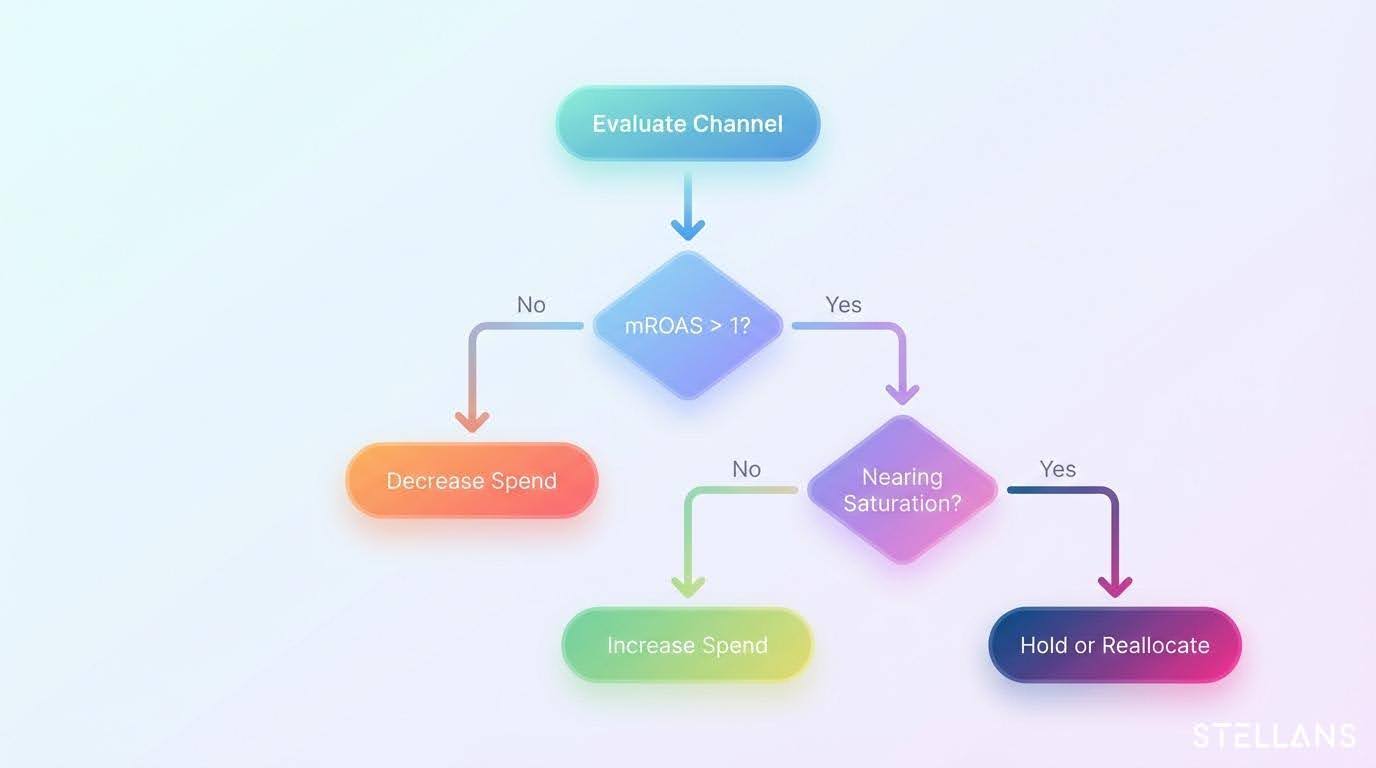
- Diminishing Returns: Your first dollar spent on a channel is almost always the most effective. However, as you continue to increase spend, the return on each additional dollar (the marginal ROI) begins to decrease until the channel becomes saturated. Modern MMM is expert at modeling these non-linear response curves, which are critical for budget optimization.