Automating Market Fundamentals Analysis with Python and Snowflake

11 minutes to read
Get free consultation


Volatile market environments demand robust data architecture. Decisions made during rapid market shifts dictate financial success. Modern financial analysts secure timely insights by bypassing manual data entry. Implementing systematic data collection eliminates immense operational drag natively. Replacing complex spreadsheets prevents them from becoming unversioned or bloated files. These automated methods reliably generate fresh financial data across your organization.

We expertly transform fragile workflows into highly automated pipelines. The modernization of financial analysis transitions workflows into a scalable, centralized data warehouse. In this comprehensive guide, we construct a blueprint for this transition. We outline the steps to curate a powerful, industrial-grade data infrastructure specifically built for automated stock analysis. By fusing resilient storage with advanced programmatic logic, teams unlock immense value. We prioritize engineering a well-oiled data machine over implementing simple predictive machine learning tools out of the box. Our core goal is to actualize your operational excellence. We work with you to unlock data potential at every tier of your business. Clients adopting these modern data practices routinely report 40% faster insights post-implementation. Let us dissect the mechanics driving this transformation.

Understanding Market Fundamentals in Modern Financial Data Analysis

Accurately defining key market data points builds the base of any capable financial strategy. A pristine data repository guarantees precise financial data analysis. Market fundamentals define the core operational health of any publicly traded entity. They systematically introduce clear analytical reasoning to stock analysis. Consistently curating this fundamental data requires significant data engineering expertise.

Core Financial Statements and Ratios

The fundamental building blocks of market tracking stem from standardized quantitative disclosures. Technical teams and analysts universally rely on core financial statements to benchmark progress. These highly regulated documents encompass the income statement, balance sheet, and statement of cash flows. Every historical performance indicator flows directly from these centralized filings. They provide a firm, chronological truth detailing a company’s exact operational output.

Analysts extract critical valuation ratios from these mandatory filings. Return on Equity (ROE) dictates how efficiently management generates profit from shareholder investments. The Price-to-Earnings (P/E) ratio provides immediate relative valuation context against market peers. The Enterprise Value to EBITDA (EV/EBITDA) multiple contextualizes a firm’s core operational strength. It strips away variable capital structure distortions. Extracting and calculating these inputs reliably demands highly repeatable programmatic processes. Automated extraction fosters highly precise analytical consistency.

The Shift to Extended Fundamentals

Holistic investment strategies now require greater depth than standard quantitative reports provide. The modern trading ecosystem dictates the ingestion of extended fundamentals. These supplementary layers incorporate alternative data points and robust Environmental, Social, and Governance (ESG) scoring frameworks. Integrating ESG metrics uncovers deeper insights that traditional balance sheets often mask. Evaluating alternative data layers unearths proactive signals of future business performance. Gathering and structuring these fragmented sets securely encourages organizations to deploy highly adaptive data models.

Ingesting and Modeling Market Fundamentals Data in Snowflake

Replacing manual data entry with programmatic extraction restructures an entire financial baseline. The focus completely shifts toward refining investment alpha over gathering scattered numbers. Ingesting API data into Snowflake establishes a centralized, governed, and scalable repository. We design Snowflake schemas tailored uniquely for financial entities. This approach guarantees optimal query performance.

Data Sources: APIs and the Snowflake Marketplace

Securing raw inputs forms the primary milestone within data platform configurations. Verified tracking of the US stock market depends heavily on authoritative disclosures. Modern engineering layers begin data extraction at the U.S. SEC EDGAR Database. Mature data practices utilize programmatic access to financial filings to pull unadulterated quarterly submissions directly. Parsing these raw XBRL documents requires significant processing power. External third-party vendors solve this initial normalization hurdle effectively.

Premium market APIs like FactSet, Intrinio, and Alpha Vantage compile and structure this data efficiently. Additionally, the native Snowflake Marketplace provides seamless, zero-copy sharing integrations from leading data providers. This capability immediately pipes live stock market data into your warehouse. It bypasses the maintenance required for custom API pipelines completely. Organizations successfully navigate strict licensing restrictions rigorously. Deploying rigid data governance ensures complete legal compliance. Generic pipeline vendors like Fivetran frequently push superficial templates for this data movement. These standard tools treat rigid financial metrics exactly like fluid marketing logs. We custom-build finance-grade architectures to strictly maintain analytical integrity.

Structuring the Snowflake Schema Layers

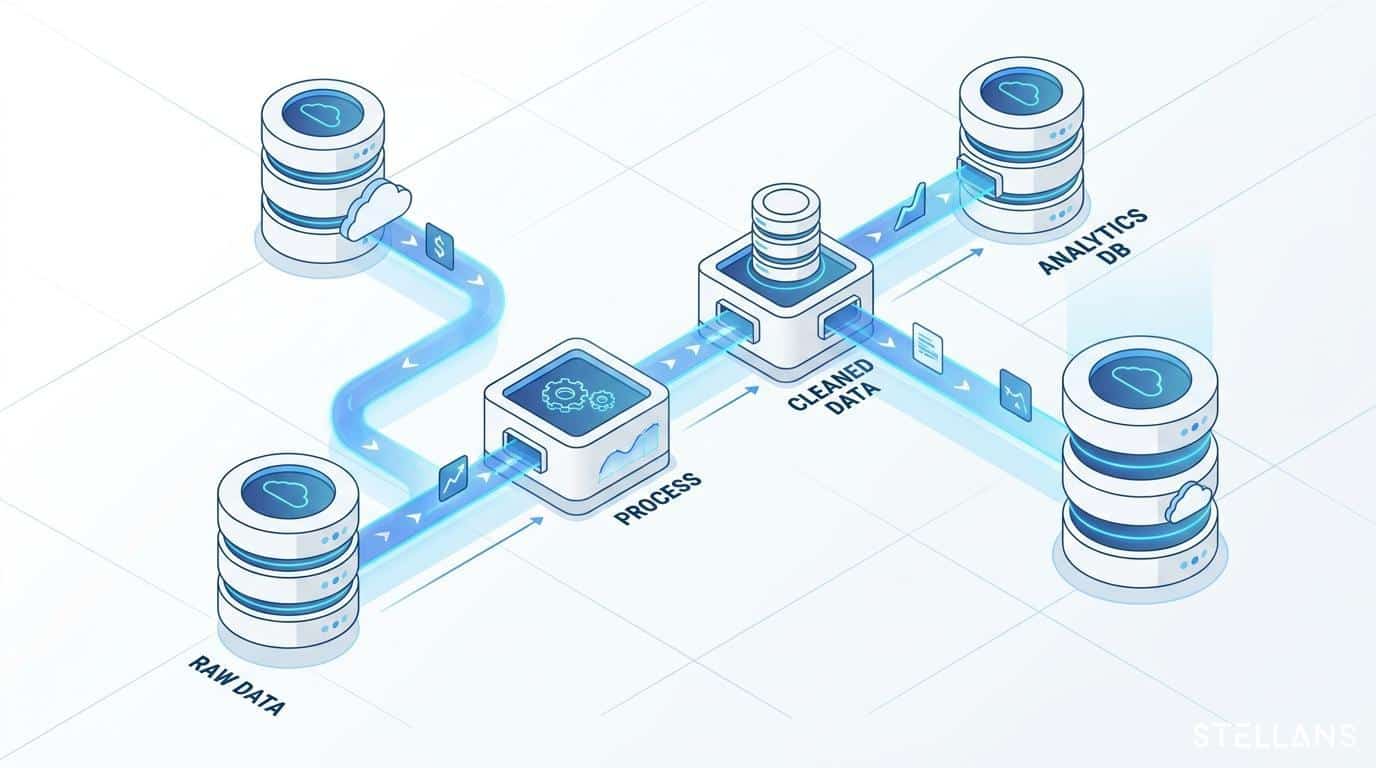
Modeling fundamental datasets inside Snowflake requires disciplined structural mapping. We deploy a proven three-tier methodology: Staging, Core, and Marts layers.

First, pipelines load raw JSON payloads into the Staging layer using Snowflake’s native VARIANT column type. We safeguard the original data state by retaining inputs exactly as they arrive. Second, the Core schema layer cleans and homogenizes these varying inputs. We flatten the nested JSON objects into strictly structured entities associated directly by financial ticker symbols. This normalizes disparate reporting standards into a single unified layout.

Finally, the Marts layer pre-computes the pivotal valuation ratios dynamically. This layer fuels downstream dashboard visualizations automatically. It ensures all business units consume uniform EV/EBITDA multiples cohesively. Structuring the warehouse aggressively maintains clear data streams. It accelerates analytical queries massively.

Implementing Finance-Grade DataOps

Deploying consistent programmatic ingestion mandates an active focus on data quality. Fresh financial data models, accurate valuations, and ensure successful investment execution. We guarantee these results by embedding stringent DataOps practices directly into the pipeline framework.

Automated auditing mechanisms drive robust DataOps principles. We utilize modern frameworks like dbt to execute recurring freshness tests on all ingestion tables. The platform immediately notifies central engineers whenever a vendor updates essential stock market news. Furthermore, we inject distinct logic tests directly into Snowflake schemas. These tests validate pristine data values before they populate business models. They intercept null outcomes in critical column metrics instantly. We integrate these sophisticated safeguards consistently. You can review our extensive configurations via our DataOps in Action case study.
Automating Fundamental Ratio Calculations Using Python

Structuring raw numerical rows fundamentally initiates the architectural phase. The ultimate business leverage materializes when we deploy scaled computations across total market equities. Using Python for fundamental ratio calculation unlocks execution speed. It establishes strict version control and immense horizontal scalability.

Integrating Python Workflows with Snowflake

A decisive architectural question asks where calculation code logically executes. Modern platforms establish robust security and system stability by migrating from fragile local computers. The introduction of the Snowpark framework universally resolves past structural limitations. Snowpark authorizes developers to run native Python scripts directly inside Snowflake infrastructure.

Executing logic natively inside the warehouse securely minimizes data movement overheads. It sharply reduces expensive network egress fees. The operation taps directly into the highly reputable scientific Python ecosystem. Teams leverage battle-tested libraries like Pandas and NumPy securely inside vast compute clusters. We empower specialized technical teams to scale operations seamlessly. Our process establishes clear management practices across synchronized servers.

Creating Automated Stock Analysis Workflows

Python scripts flawlessly convert complex spreadsheet logic into predictable algorithms. Dynamic Python algorithms reliably govern stock models when companies alter report formats. They utilize robust data frames to adapt effortlessly to missing variables.

We construct highly capable automated stock analysis workflows for our clients. These workflows iteratively scan thousands of tickers dynamically in minutes. A structured function pulls the cleansed balance sheet from the Core layer. It applies strict logic models to extract the operating margin. It sequentially writes these calculated ratios back into the designated Marts layer. A simplified representation mirrors the code outlined below:

import snowflake.snowpark as snowpark
from snowflake.snowpark.functions import col

def calculate_roe(session: snowpark.Session):
    # Extracts cleansed data from the Core layer
    df = session.table("FINANCIAL_CORE.BALANCE_SHEETS")
    
    # Calculates standardized Return on Equity programmatically
    df = df.withColumn("ROE", col("NET_INCOME") / col("SHAREHOLDER_EQUITY"))
    
    # Writes the structured metrics back to the Marts reporting layer
    df.write.mode("overwrite").save_as_table("FINANCIAL_MARTS.VALUATION_RATIOS")
    return "Calculations Complete"


This persistent loop guarantees consistent ratio accuracy. The system recalibrates fundamental tracking moments after underlying data refreshes.

Reproducibility and Versioning

Transferring calculation syntax into modern Python repositories establishes pure traceability. We collect these standardized financial ratios inside centralized internal libraries. We version these distinct factor libraries meticulously in Git. This strategy enforces profound auditability across an institution.

This process directly solves the notorious broken equation problem. When an analyst redefines a sector algorithm, developers commit the change globally. Deployment workflows apply the new logic consistently across every linked business unit. Methodological alignment soars when teams consume identical mathematical versions.

Overcoming Common Bottlenecks in Market Fundamentals Analysis

Implementing modernized data systems effectively untangles deeply rooted analytical friction. We tackle legacy constraints specifically to launch agile financial operations. We treat the central data pipeline as a highway connecting raw intelligence to executive decisions.

From Manual Data Entry to Unbroken Pipelines

Automating the extraction of digits from static PDF files maximizes the value of premium analytical talent. Constructing unbroken data sets automatically channels real-time intelligence directly into predictive models. This structural overhaul completely recovers hundreds of manual hours. Analysts refocus their energy fully on strategic market interpretation.

Eradicating Stale Data with Automated SLAs

Rapid metric tracking ensures successful investment strategy execution during market fluctuations. We encode aggressive Service Level Agreements (SLAs) deeply into the operational pipeline logic. Configured monitoring instantly highlights pipeline adjustments. Swift technical intervention guarantees your live pricing layers stay synchronized with deeper fundamentals.

Replacing Complex Spreadsheets with Centralized Metrics

Centralizing data systems supports enterprise scaling effectively. Establishing centralized Snowflake schema objects creates unified data narratives across all departments. Every downstream visualization dashboard extracts elements from this singular governed source.

Advanced Market Fundamentals Analysis Techniques

Once organizations solidify fundamental data pipelines, they unlock deeply sophisticated techniques. A rigorously engineered core permits the execution of complex theoretical scenarios effortlessly.

Building Factor Models and Risk Analytics

Commercial machine learning platforms generate optimal predictive modeling output when supported by a diligently structured foundational layer. We architect discrete programmatic models generating multi-layered risk analytics. These applications weigh and rank institutional equities dynamically. The systems parse blended momentum indicators with operational metrics automatically. We repeatedly scale systemic capabilities while building forecasting and optimization models, mapping directly to dynamic markets.

Handling Hybrid Architecture: Real-Time vs. Batch Data

Financial infrastructure builders consistently orchestrate contrasting data velocities cleanly. Standard fundamental disclosures deploy via large quarterly batch loads sequentially. Consequently, trading algorithms require high-frequency sub-second ingestion to capture profitable movements. We synthesize these speeds by constructing specialized hybrid data layouts. We routinely integrate live streaming data frameworks with persistent warehouse storage. You can observe our approach in detail within our Architecting for Real-Time infrastructure breakdown.

Why Choose Stellans for Your Market Fundamentals Automation

We empower your organization to control technology proactively. Shielding a firm against volatile markets demands a highly verticalized engineering perspective. We provide strict architectural discipline optimized precisely for the financial services sector.

Proven End-to-End Modern Data Stack Capabilities

Stellans delivers exact, proven blueprints solving distinct sector challenges. Our frameworks govern extraction logic, schema normalization, and rapid Python deployment identically. We record clear, tangible success scaling pure API feeds into robust modern platforms. We routinely deploy Data Platform Modernization & Warehouse Migration capabilities perfectly suited for these exact scaling constraints. We act directly as your dedicated empowering partner. We navigate complex infrastructure migrations securely to elevate your daily operations. Our ultimate mission remains your sustainable technical growth.

Conclusion & Next Steps

Executing modernized financial analysis requires sophisticated tools. Automating market fundamentals integrates precise warehouse structures with sheer computational efficiency. When executed properly, this methodology expands technical capabilities dramatically. It entirely refreshes performance figures and neutralizes individual spreadsheet risk.

Clients adopting this synchronized approach report 40% faster insights consistently. This rapid iteration speed furnishes profound strategic separation from competitors. If you wish to build custom fundamentals pipelines that scale, explore our full Advanced Data Science implementations today. We stand ready to optimize your financial data footprint.

Frequently Asked Questions

How to use Python to analyze the stock market? Python enables users to extract raw market information, normalize financial metrics, and compute complex ratios automatically. Data engineers deploy structured libraries like Pandas to clean raw SEC filings seamlessly. Executing Python directly lets analytical teams study historical variance and project sophisticated performance models.

Does Snowflake work with Python? Yes, Snowflake integrates deeply with Python language executions via the Snowpark feature. Snowpark permits engineers to script and launch Python syntax directly inside cloud warehouse borders. This distinct capability halts costly data movement and deeply optimizes processing speeds.

How to use Snowflake for data analysis? Snowflake streamlines quantitative data analysis by introducing a completely centralized logical repository. Businesses load unstructured formats directly into designated staging schemas. Engineers transform this disparate data into clean reporting marts using SQL or Python. Analysts then query these validated layers rapidly.

References

Article By:

https://stellans.io/wp-content/uploads/2026/01/leadership-1-1.png
David Ashirov

Co-founder

Related Posts

    Get a Free Data Audit

    * You can attach up to 3 files, each up to 3MB, in doc, docx, pdf, ppt, or pptx format.