Data Lake vs Data Warehouse vs Data Mart: Enterprise Guide

18 minutes to read
Get free consultation

Data Lake vs Data Warehouse vs Data Mart: Modern Infrastructure Guide

Data architecture dictates business velocity. Enterprise technical leaders face mounting pressure to deliver faster insights. They must also control skyrocketing cloud infrastructure costs. Choosing the right storage layer is no longer just a technical decision. This choice determines your company’s operational efficiency.

You might evaluate a data lake for raw scalability. You might consider a data warehouse for structured performance. You might look at data marts for business-unit agility. The truth is simple: modern enterprises often need elements of all three. Deploying them correctly optimizes compute costs and creates unified data ecosystems.

We advocate for architecture discipline over platform advocacy. You should use the least expensive storage layer that satisfies your specific workload. You can then add deliberate data governance to maintain control. We work with you to unlock data potential. Our goal is your growth.

This guide breaks down the core differences between these three paradigms. We will explore how they integrate within a modern cloud ecosystem. We will also demonstrate how to build a well-oiled data machine using tools like Snowflake and Fivetran.

The Evolution of Modern Cloud Data Storage

Enterprise data storage has evolved rapidly over the last decade. Modern cloud solutions eliminate the massive upfront capital expenditures of early on-premise solutions. Companies initially bought physical hardware to store limited structured data, but cloud infrastructure provides the flexibility needed for rapid scaling.

The cloud computing revolution changed everything. Storage costs plummeted. Compute power became accessible on demand. Businesses began capturing massive volumes of digital information. This influx included structured transaction records and unstructured telemetry logs.

This data explosion created a new opportunity. Engineers designed a new paradigm to store raw data cheaply when the sheer volume of unstructured information exceeded the capabilities of traditional databases. This requirement birthed the data lake. Meanwhile, business intelligence teams still needed fast query performance. They required the structured reliability of a data warehouse.

Today, managing cloud bills is a massive priority for engineering directors. Well-designed architectures ensure predictable compute costs. Streamlined data processing conserves valuable resources, and active cluster management preserves IT budgets.

Choosing the right storage architecture matters immensely. The correct layout controls your costs. It also accelerates your insights. You must match the storage type to the specific business use case. This strategic alignment ensures maximum return on your technology investment.

Core Definitions and Architectural Concepts

Technical leaders must understand the fundamental differences between storage layers. Each paradigm serves a distinct purpose. They operate under different structural philosophies.

What is a Data Lake?

A data lake is a vast storage repository. It holds a massive amount of raw data in its native format. This format can be structured, semi-structured, or completely unstructured. Data lakes use flat architecture to store files. They rely on object storage like Amazon S3 or Google Cloud Storage.

The defining characteristic of a data lake is “schema-on-read.” You store the data directly in its native format. You effortlessly store the files in the lake. You only apply a schema when you query the data. This approach provides incredible flexibility.

Data lakes offer massive scalability at a very low cost. You pay pennies for gigabytes of storage. Data scientists love data lakes for machine learning workloads. They can access raw telemetry and unedited logs directly.

Data lakes operate optimally with careful administration. They thrive on strict metadata management. Proper governance ensures a lake remains a structured, accessible repository rather than an undocumented collection of files. Organized environments guarantee users find the data they need quickly, maintaining high trust in data quality.

What is a Data Warehouse?

A data warehouse is a centralized repository for structured data. It stores highly refined data optimized for analytics. Warehouses pull data from multiple operational systems. They integrate this information to support business intelligence (BI).

Data warehouses operate on a “schema-on-write” philosophy. You must define the structure before you load the data. Data engineers use Extract, Transform, Load (ETL) processes to format the information. The warehouse accepts only data that conforms to the defined schema.

This strict structure guarantees data integrity. It enables highly optimized SQL queries. Business analysts rely on data warehouses for critical reporting. Dashboards load quickly because the data is pre-modeled.

Modern cloud data warehouses separate storage from compute. Snowflake pioneered this architecture. You can scale your processing power without buying more storage. This elasticity helps manage financial resources. However, warehouse storage remains more expensive than data lake object storage.

What is a Data Mart?

A data mart is a specialized subset of a data warehouse. It focuses on a single functional area of a business. A data mart might serve the finance team exclusively. Another mart might hold only marketing campaign data.

Data marts contain highly curated, domain-oriented datasets. They accelerate query performance for specific business units. Users scan only the domain-specific data, avoiding the need to process the entire enterprise warehouse. They only interact with data relevant to their daily tasks.

Historically, companies built physical data marts. They copied data from the main warehouse into separate, isolated databases. Modern logical data marts resolve the isolated data silos and duplicated storage costs associated with this historical practice.

Today, we see the evolution of logical data marts. Modern cloud warehouses support distinct virtual environments. You can create logical marts using dedicated schemas and role-based access controls. This approach provides domain isolation without physical data duplication.


High-Contrast Comparison: Data Lake vs Data Warehouse vs Data Mart

You must evaluate these architectures side-by-side to make informed decisions. We have mapped the core attributes of each storage layer below. This comparison highlights the structural trade-offs.

Feature Data Lake Data Warehouse Data Mart
Primary Data Type Raw, Unstructured, Semi-structured Refined, Highly Structured Curated, Domain-Specific
Storage Cost Very Low Medium to High Medium (High if physical copy)
Access Latency High (Slowest queries) Low (Fast queries) Very Low (Fastest for specific domain)
Schema Enforcement Schema-on-Read Schema-on-Write Schema-on-Write
Typical Users Data Scientists, ML Engineers Data Analysts, BI Developers Business Unit Managers, Operations
Typical Queries Exploratory, Predictive Modeling Enterprise BI, Historical Trends Departmental KPIs, Tactical Reporting
Agility High flexibility for new data Lower flexibility (requires modeling) High relevance for end-users

This table reveals a fundamental truth. A tailored combination of layers solves diverse enterprise problems. You use a data lake for cheap, limitless retention. You use a data warehouse for trusted, governed metrics. You use a data mart for rapid departmental insights.

Modern Cloud Architecture Patterns for Enterprises

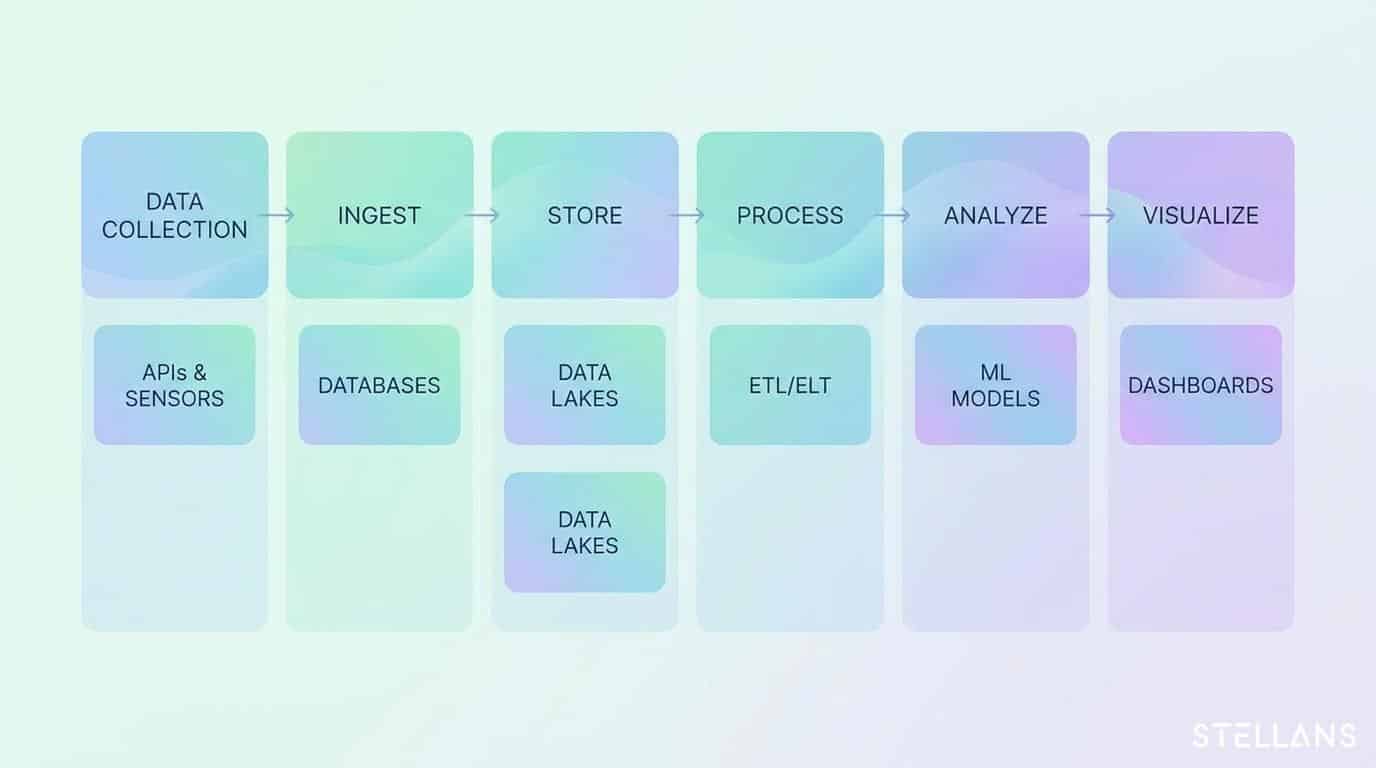
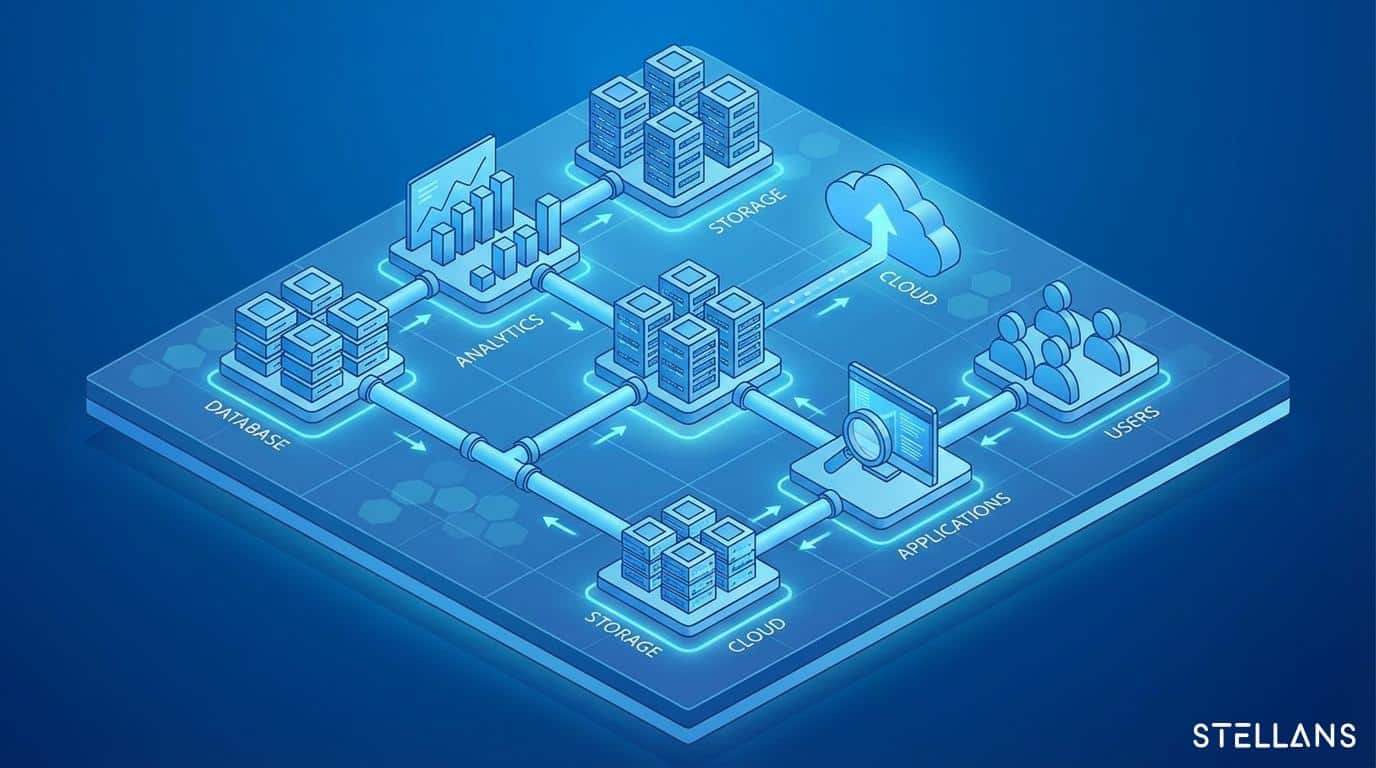
Understanding the individual components is only the first step. You must assemble these parts into a cohesive system. Modern enterprise architecture patterns dictate how data flows through your organization. We will explore three dominant layouts.

The Warehouse-Centered Architecture

The warehouse-centered architecture is highly popular for mid-sized enterprises. All analytical data flows directly into a central cloud data warehouse. This pattern prioritizes strict data governance. It ensures a single source of truth for the entire company.

In this model, raw data lands in a staging area within the warehouse. Data engineers then transform it into structured tables. Analysts query these tables using standard SQL. This setup simplifies the technology stack. It reduces the number of distinct platforms your team must manage.

This pattern remains highly efficient for structured data, whereas storing massive volumes of unstructured log data requires careful budget management. The compute power required to parse raw JSON inside the warehouse is also costly. This architecture works best for companies with primarily structured operational data.

The Hybrid Data Lakehouse

The hybrid data lakehouse bridges the gap between lakes and warehouses. It combines the cheap storage of a data lake with the management features of a warehouse. This architecture relies on open table formats like Apache Iceberg or Delta Lake.

The lakehouse pattern keeps all data in cheap object storage. However, it applies a transactional metadata layer on top of the files. This layer enables ACID compliance. It allows users to run complex SQL queries directly against the data lake.

This hybrid approach maintains vendor flexibility. It supports both machine learning and BI workloads on a single platform. We frequently recommend this pattern for enterprises with massive unstructured datasets. It significantly lowers total cost of ownership for high-volume environments.

Domain-Oriented Data Products (Logical Marts)

Modern enterprises are moving toward decentralized data ownership. This shift introduces the concept of data mesh and domain-oriented data products. We implement this pattern using logical data marts.

Data Marts derive from modern cloud warehouses instead of existing as siloed platforms. We build a robust central warehouse first. We then construct logical boundaries for different business units. We use tools to model these domain-specific views securely.

This architecture prevents the fragmentation of the past. The finance team gets a dedicated, high-performance logical mart. The marketing team gets their own customized metrics. Both teams query the same underlying physical data. This pattern delivers localized agility while maintaining centralized governance.

Logical Decision Tree: How to Choose Your Data Storage Layer

Technical leaders need a clear methodology for routing workloads. Deploying infrastructure based on a structured evaluation path yields the best results. We use a logical decision tree to help clients choose their ideal layout.

Follow this structured evaluation path to map your enterprise workloads:

Step 1: Evaluate the Data Structure

Step 2: Evaluate the End-User Profile

Step 3: Evaluate the Performance and Governance Needs

Step 4: Evaluate the Scope of the Analytics

This decision tree provides absolute clarity. It ensures you always pay optimal object storage prices for raw logs and consistently provide business analysts with cleanly structured data. You align the technology with the explicit business requirement.

Overcoming Top Data Infrastructure Pain Points

Active management ensures enterprise data environments thrive, overcoming the real-world friction that all architectural plans encounter. We help clients navigate these inevitable challenges. We focus on three major infrastructure pain points.

Curing the Messy Data Lake

A well-maintained data lake accelerates an engineering team. Automated metadata tags ensure files remain organized and distinct. Engineers find the exact datasets they need in minutes, allowing the business to benefit fully while avoiding the cost of poor data quality.

We cure data swamps by implementing strict ingestion protocols. You must enforce metadata tagging at the point of entry. We establish automated cataloging tools. These tools scan new files and update a central data dictionary.

We also implement data lifecycle policies. Stale data must move to colder, cheaper storage tiers automatically. You must delete obsolete data to reduce clutter. A well-oiled data machine requires continuous maintenance and ruthless organization.

Accelerating Slow Query Performance

Lightning-fast query performance guarantees user adoption. Business leaders rely consistently on dashboards that load instantly. Proper data modeling and adequate compute provisioning directly enable this essential speed.

We solve query latency by optimizing the physical storage layer. We cluster data based on common query patterns. This technique minimizes the amount of data the system must scan.

We also leverage materialized views for complex, frequently run queries. A materialized view pre-computes the results of a query. The database stores these results physically. Users experience instantaneous dashboard load times. We actively monitor query execution plans to identify and fix bottlenecks.

Taming Skyrocketing Cloud Bills (FinOps)

Cloud infrastructure provides incredible power. Proactive FinOps practices protect IT budgets globally from unpredictable cloud bills. Enterprises secure their financial stability by adopting these cost-management strategies.

FinOps combines financial accountability with technical operations. We help teams understand their shared cloud cost management responsibilities. You must attribute compute costs to specific business units. This transparency changes consumption behavior immediately.

We apply strict frugal architecture laws to our designs. We implement auto-suspend policies for idle compute clusters. We set hard limits on query execution times. We regularly audit storage layers to eliminate redundant physical data marts. Cost optimization is a continuous engineering discipline.

Case Study: Data Integration with Fivetran & Snowflake

Theory requires practical execution to deliver value. Stellans partners with enterprises to build robust, scalable infrastructure. We frequently deploy a specific integration pattern to solve complex storage challenges. We rely heavily on Fivetran and Snowflake.

Our implementation methodology focuses on speed and reliability. We streamline your engineering processes by managing custom API maintenance. Clients report 40% faster insights post-implementation. You can explore our specific approach to Data Integration with Fivetran & Snowflake.

Automated Ingestion and Change Data Capture (CDC)

Automated ingestion tools like Fivetran offer stability where custom scripts fall short. They seamlessly handle changing API endpoints, unpredictable data volume spikes, and the maintenance overhead of manual ETL pipelines. Fivetran automates data ingestion from hundreds of operational sources.

We utilize Change Data Capture (CDC) for database replication. CDC is a game-changer for latency. Traditional batch ingestion queries the entire source database. This process degrades operational performance. It also wastes massive compute resources.

CDC operates differently. Fivetran reads the database write-ahead log directly. It only extracts the row-level changes that occurred since the last sync. This micro-batch approach drastically reduces source system impact. It delivers near real-time data into Snowflake. CDC reduces latency while simultaneously lowering compute costs.

Modeling Downstream Data Marts with dbt

Raw data in Snowflake requires straightforward transformation into logical data marts for optimal business consumption. We use a data build tool (dbt) to handle this transformation layer. dbt brings software engineering best practices to data analytics.

We write modular SQL scripts in dbt. We version-control these scripts using Git. This process ensures error-free reporting. We construct a central data warehouse model first. We then build targeted logical data marts on top.

These logical marts manifest as secure views in Snowflake. Downstream BI tools like Tableau or Looker connect directly to these views. The business units get clean, domain-specific data. We maintain strict governance while optimizing costs by eliminating physical storage duplication. This architecture is highly scalable and deeply cost-effective.

Implementing AI and Governance Across Your Infrastructure

Modern storage architecture enables advanced use cases. Clean data forms the reliable foundation required for successful artificial intelligence deployment. Machine learning models require vast amounts of high-quality training information. Your data lake and data warehouse serve as the foundational engine for AI.

We design and implement AI solutions tailored to real business needs. You can explore these capabilities through our AI solutions tailored to real business needs. A well-structured data layer allows you to automate tasks and build predictive models confidently.

Security and compliance remain essential as new regulations demand strict control over personal data. You must track data lineage from ingestion to dashboard. You must mask sensitive fields before they enter a downstream data mart.

We help manage risks and ensure compliance. We work alongside your team to set strong governance foundations for technology. Governance stands as a foundational priority in modern enterprise data architecture.

Frequently Asked Questions

What is the difference between a data warehouse and a data lake? A data warehouse stores highly structured data optimized for business intelligence. It uses schema-on-write. A data lake stores raw, unstructured data in its native format. It uses schema-on-read. Warehouses prioritize performance, while lakes prioritize infinite, cheap storage.

Can a data mart exist without a data warehouse? Historically, yes. Independent data marts were built directly from operational systems. However, this creates dangerous data silos and inconsistent metrics. Modern architecture mandates that data marts derive logically from a central data warehouse.

Why are cloud data warehouse costs so difficult to predict? Cloud warehouses often separate computers from storage. You pay for the time queries run. Poorly written SQL, lack of indexing, and unoptimized data models cause queries to scan unnecessary data. This excessive scanning drives up unpredictable computer costs rapidly.

How does Fivetran improve data architecture? Fivetran automates the extraction and loading phases of data integration. It uses log-based Change Data Capture (CDC) to minimize system impact. It ensures your data warehouse always has fresh, accurate data without requiring manual engineering maintenance.

Conclusion: Build Your Data Engine with Stellans

Choosing between a data lake, a data warehouse, and a data mart is a strategic imperative. You must align your storage layer with your specific business workloads. A hybrid approach often yields the best results. You need the cost-efficiency of a lake. You need the governance of a warehouse. You need the agility of logical marts.

Implementing this architecture requires discipline. You must conquer messy data swamps. You must accelerate slow queries. You must enforce rigorous FinOps principles to control cloud bills.

We build scalable systems that fuel growth and innovation. Stellans acts as your empowering partner in this journey. We translate complex technical decisions into clear business outcomes. Our implementation-first approach ensures your data pipeline acts as a high-speed highway.

We invite you to stop managing infrastructure and start driving insights. You can reach out to Stellans today. Let us help you architect a scalable, cost-effective data engine for your enterprise.

References

Article By:

https://stellans.io/wp-content/uploads/2026/01/leadership-2.jpg
Anton Malyshev

Co-founder

Related Posts

    Get a Free Data Audit

    * You can attach up to 3 files, each up to 3MB, in doc, docx, pdf, ppt, or pptx format.
    This site is protected by reCAPTCHA and the Google Privacy Policy and Terms of Service apply.