Data Preparation for Accurate Forecasting: 7 Best Practices

11 minutes to read
Get free consultation

Why Sandboxes Matter for Forecast Accuracy and Governance

Analytics sandboxes are the R&D labs of your data world: they fuel innovation, enable forecasting experiments, and empower analysts. However, they can feel risky when safeguards lag behind business needs. Security leads and data platform architects face a tough choice: enable freedom to explore or enforce strict controls but slow insights. Many organizations still struggle with ill-defined, under-governed sandbox environments, creating exposure points for sensitive data and compliance challenges.

At Stellans, we promote a better approach: a secure, platform-agnostic analytics sandbox setup that unlocks creativity while reducing risk. Below, we outline actionable best practices to help you design and operate sandboxes that drive accurate forecasting with controls aligned with frameworks like NIST SP 800-53 Rev. 5, ISO/IEC 27001, and EU data protection.


What a Secure Analytics Sandbox Is and Why It Matters

Definition and Objectives

A secure analytics sandbox is a segregated environment—think of it as a “virtual cleanroom”—designed for data experimentation, model development, and hypothesis testing. It achieves three core objectives:

Business Impact: Faster Experiments, Lower Compliance Risk

A well-governed analytics sandbox accelerates the path from idea to tested solution. Key benefits include:

Best Practice 1: Implement Robust Access Control Strategies

RBAC and ABAC for Least Privilege

Every sandbox should enforce access control using a blend of role-based (RBAC) and attribute-based (ABAC) models. This approach allows users to see just enough to do their job, and no more. ABAC enables fine-grained restrictions based on project, location, or data sensitivity, while RBAC manages team roles. All users operate under the principle of least privilege.

JIT Access, Approval Workflows, Time-Bounded Roles

We recommend configuring just-in-time (JIT) access—granting temporary, auditable permissions that expire after the task is complete. Access windows should be short, typically 4 to 8 hours, with clear approval workflows to limit exposure while maintaining velocity.

Practical Example: Analyst Persona Access Matrix

Persona Default Access Elevation Option Max Elevation Duration
Data Analyst Masked tables, BI Temporary SQL write 4 hours
Data Scientist Masked & synthetic Add dev library/compute 8 hours
Platform Engineer Infra configs User management, audit logs 4 hours (with approval)

All elevation requests are logged and reviewed to maintain compliance.

In one engagement, integrating RBAC, dynamic masking, and JIT access lowered data breach risk by 60%, while reducing access approval wait times by 50%.

Mapped controls: NIST AC-2, AC-3; ISO 27001 Annex A.9/A.12.

Best Practice 3: Architect Isolation Between Production and Sandbox

Network Segmentation, Private Endpoints, Scoped VPCs/Compartments

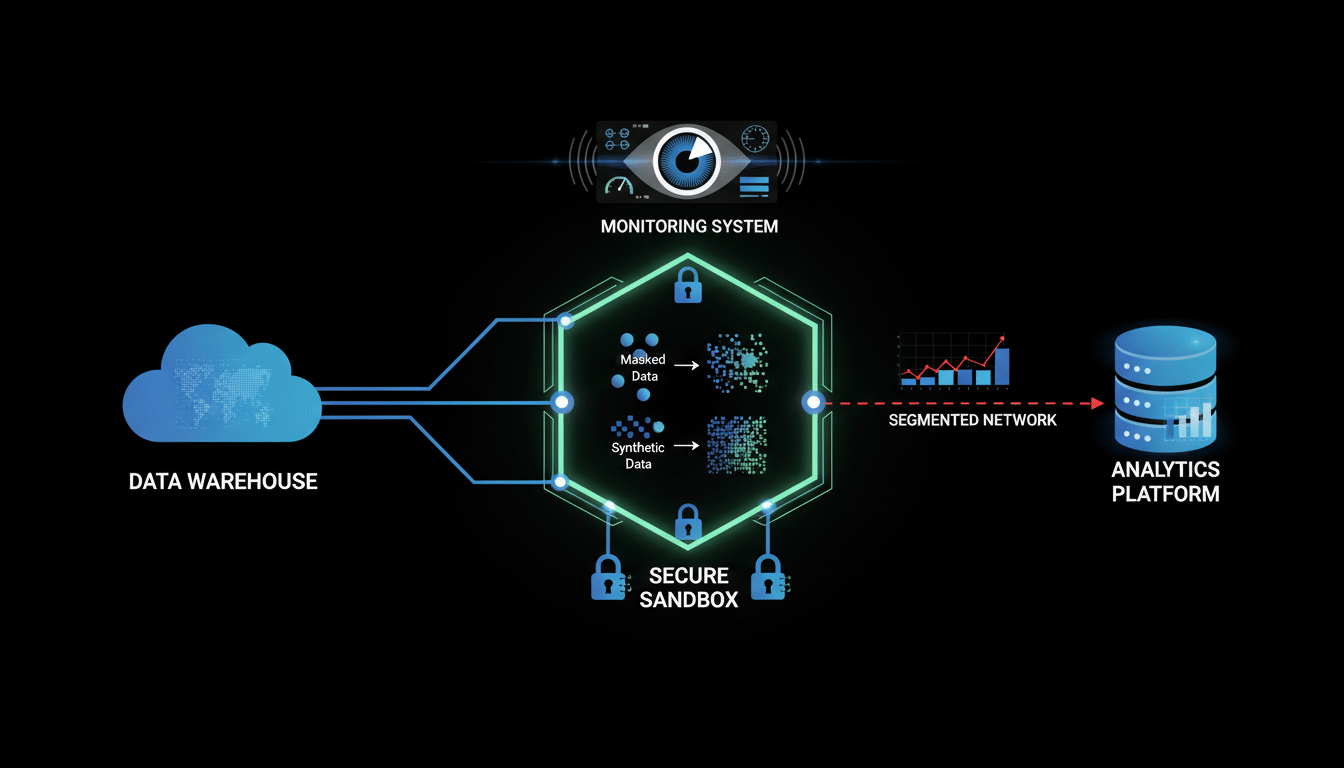
Effective sandbox architecture keeps production and sandbox environments “air-gapped” using distinct networks, isolated compartments or VPCs, and controlled endpoint exposure. This approach shields production workloads from experimentation risks.

Read-Only Replicas, Curated Extracts, or Air-Gapped Datasets

Ensure data flows are strictly one-way: export only what is essential via read-only replicas or curated extracts that remove high-risk fields. For highly sensitive projects, pre-build air-gapped synthetic datasets for experimentation.

Callout: Secure Analytics Sandbox Architecture Diagram

graph TD
  A[Prod DWH/DB (Read-only)] -->|Curated extracts| B[Data Prep Zone]
  B -->|Mask/Tokenize| C[Masked Dataset]
  B -->|Generate| D[Synthetic Dataset]
  C --> E[Sandbox Storage]
  D --> E
  E --> F[Analytics Tools (Notebooks/BI)]
  subgraph Security
    G[RBAC/ABAC/JIT]
    H[Audit Logs/SIEM]
    I[Policy-as-Code]
  end
  G -. control .-> F
  H -. monitor .-> E
  I -. enforce .-> B

Stellans Secure Analytics Sandbox Setup provides these guardrails simply: we blueprint, configure, and operate a fully compliant, governed sandbox environment tailored to your stack. Learn about our offering and outcomes.

Best Practice 4: Monitor and Audit Continuously

Audit Logs, Anomaly Detection, SIEM Integration

Capture all sandbox activity in detailed audit logs covering logins, queries, data exports, and configuration changes. We recommend integrating continuous monitoring with SIEM tools for baseline analytics, anomaly alerts, and compliance dashboards. Tools like OCI Cloud Guard or platform equivalents can automate detection and action.

Policy-as-Code and Automated Remediation

Enforce sandbox procedures—such as access time limits or dataset expiration—using policy-as-code frameworks like Terraform or OPA. Automated remediation triggers contain threats quickly when anomalies or violations occur.

Standards referenced: NIST SI-4, AU-2; ISO/IEC 27001 Annex A.12/A.16. For SaaS-specific guidance, see CSA sandbox security.

Best Practice 5: Govern Metadata, Lineage, and Retention

Data Catalog, Lineage, Data Contracts

Maintain a complete catalog for all sandboxed datasets, including their origin (lineage), masking/synthesis methods, and approved users. Data contracts make sure only appropriate resources feed into the sandbox.

Retention Policies, TTLs, Cost Controls

Set clear Time-to-Live (TTL) defaults so sandbox data auto-expires in 30 to 90 days unless renewed by exception. Additionally, apply cost guardrails with budget alerts at 80% and 100% capacity and enforce cleanup cycles.

Best practice is to link sandbox records and lineage to your Data Governance & Compliance services for recurring audits and reporting.

Best Practice 6: Promote Work to Production Safely

Version Control, Peer Review, dbt Tests, CI/CD

Make promotion from sandbox to production repeatable, testable, and auditable. Use version control (e.g., Git), code and data peer review, and automated dbt tests to ensure quality.

Validation Gates: Data Quality SLAs, Rollback Plans

Staging environments should mirror production where possible. Apply validation gates for schema compliance, data SLAs, and implement rollback plans. Every promotion must leave an audit trail.

Checklist: Safe Promotion to Production (Stellans Approach)

See how our Secure Analytics Sandbox Setup accelerates time-to-insight while protecting sensitive data—talk to us.

Best Practice 7: Educate and Empower Analysts

Training, Self-Service Templates, “Guardrails not Gates”

Analysts perform best when they understand the “why” and “how” behind sandbox controls. We recommend practical onboarding training, self-service workspace templates, and transparent guidelines to enable safe exploration.

KPI Dashboard for Sandbox Health

Visualize usage, compliance events, time-to-validation, and costs in a sandbox KPI dashboard. This tool gives analysts, engineers, and security leads the insights needed to act efficiently.

How Stellans Helps: Secure Analytics Sandbox Setup

Our Approach: Blueprint, Build, Operate with Your Team

We collaborate with data platform architects, security leads, and analysts to co-design sandbox architectures that balance security and speed. Our process involves assessing your data flows, mapping controls to NIST SP 800-53 Rev. 5, ISO/IEC 27001, and GDPR, then building and operationalizing a sandbox environment tailored to your ecosystem.

Expected Outcomes and Timeline

Clients typically see 40% faster analytics onboarding, less than 60% reduction in compliance incidents, and a significant improvement in safe data experimentation. Most projects launch within 4 to 8 weeks.

Explore our Stellans Secure Analytics Sandbox Setup. We also offer Data Governance & Compliance services and Analytics Engineering and CI/CD for full lifecycle support.

Conclusion

Driving innovation in forecasting requires balancing creative freedom with controls that safeguard production data, privacy, and compliance. These seven best practices empower your analytics team to innovate with reduced risk and operational drag.

Ready to build a secure, governed analytics sandbox that accelerates insights while protecting sensitive data? Contact Stellans. Our team is ready to create a solution tailored to your business.

Frequently Asked Questions

What are best practices for secure data sandbox architecture?
Isolate sandboxes from production with network segmentation and read-only data feeds. Enforce RBAC/ABAC with least privilege. Use masked or synthetic data. Monitor and audit continuously. Apply a gated CI/CD path for promotion.

How can access control strategies improve sandbox security?
Combine role- and attribute-based access with time-bound entitlements and just-in-time elevation to minimize exposure. Automate approvals and logging for full audit trails.

What is the difference between masked and synthetic data?
Masked data transforms sensitive fields while keeping the schema intact. Synthetic data generates statistically similar, artificial records. Mask data when schema fidelity is critical; choose synthetic data to reduce privacy risk.

How do you monitor sandbox environments effectively?
Centralize audit logs, baseline normal activity, alert on anomalies, and enforce policies as code with automated remediation. Integrate with SIEM tools for investigation and reporting.

What are key steps to safely promote sandbox work to production?
Use version control, peer review, and automated tests for data quality and schema contracts. Validate against production-like data. Require change approvals and maintain rollback plans.


Ready to build a secure analytics sandbox? Contact Stellans to see how we can help you accelerate insights while protecting sensitive data.

References:

Article By:

https://stellans.io/wp-content/uploads/2024/06/IMG_5527-2-1.png
Vitaly Lilich

Co-founder & CEO at Stellans

Related Posts

    Get a Free Data Audit

    * You can attach up to 3 files, each up to 3MB, in doc, docx, pdf, ppt, or pptx format.