Audit Log Retention Compliance: The Complete Guide for Data Platform Teams

18 minutes to read
Get free consultation


Compliance officers and data platform administrators face a persistent challenge: how long should audit logs be retained to satisfy regulatory requirements without drowning in storage costs? The answer varies dramatically depending on which regulations apply to your organization, and getting it wrong can result in failed audits or unnecessary expenses.

In our work with regulated enterprises, we see organizations often default to indefinite retention to be safe, which causes storage costs to balloon year over year. Others purge logs too aggressively, only to find during an audit that critical records are missing.

This guide provides a practical framework for implementing compliant audit log retention policies in modern data platforms, with specific guidance for Snowflake environments. We will walk through the exact retention requirements for major regulations, share best practices for tiered storage strategies, and show you how to automate log lifecycle management.

Why Audit Log Retention Matters for Regulated Industries

Audit logs serve as the forensic backbone of your data security program. They document who accessed what data, when they accessed it, and what actions they performed. Proper log retention allows organizations to investigate security incidents, demonstrate compliance to auditors, and respond to legal discovery requests.

The $4.88 Million Data Breach Reality

According to the IBM Cost of a Data Breach Report 2024, the average global breach cost reached $4.88 million, representing a 10% increase from the previous year. Organizations with strong logging capabilities detect breaches faster and face lower remediation costs. Proper audit log retention reduces mean time to detect (MTTD) security incidents and provides the evidence trail needed to contain threats quickly.

Common Compliance Audit Failures

Many organizations succeed less during compliance audits when they cannot produce the required log records. Common failures include:

These failures lead to audit findings, remediation requirements, and in severe cases, regulatory penalties. A healthcare client we worked with received a formal warning from auditors because they could not produce six years of access logs for systems handling protected health information (PHI).

Audit Log Retention Requirements by Regulation

https://stellans.io/wp-content/uploads/2026/01/stellans2026-01-13T20_23_02.200Z.png

Different regulations mandate different retention periods, and organizations subject to multiple frameworks must design policies that satisfy the strictest requirements. The following breakdown covers the major compliance frameworks affecting data platforms.

HIPAA: 6-Year Minimum for PHI Systems

The Health Insurance Portability and Accountability Act (HIPAA) Security Rule requires covered entities and business associates to retain documentation of security policies and procedures for six years from the date of creation or last effective date. This includes audit logs that track access to protected health information.

Key HIPAA logging requirements include:

SOX (Sarbanes-Oxley): 7-Year Financial Records Retention

The Sarbanes-Oxley Act, enforced by the SEC, requires public companies to retain audit records relevant to financial statements for seven years after the auditor concludes the audit or review. This applies to logs documenting access to financial systems and databases containing material financial information.

SOX audit trails must capture:

PCI-DSS 4.0: 12 Months with 3-Month Immediate Access

The Payment Card Industry Data Security Standard version 4.0 requires organizations handling cardholder data to retain audit log history for at least 12 months, with at least three months immediately available for analysis. This shorter retention period reflects the time-sensitive nature of payment fraud investigations.

PCI-DSS logging must capture:

SOC 2: Risk-Based Retention Framework

SOC 2 does not prescribe specific retention periods. Instead, it requires organizations to establish and follow documented retention policies based on risk assessment and operational needs. Most SOC 2 auditors expect organizations to retain security logs for at least one year, though periods of 90 days to three years are common depending on the trust services criteria being evaluated.

GDPR: Data Minimization vs. Security Needs

The General Data Protection Regulation presents particular challenges since it requires data minimization, meaning personal data should not be kept longer than necessary. Organizations must balance this requirement against legitimate security needs for maintaining audit trails. The key is documenting retention justifications and ensuring logs containing personal data are protected accordingly.

ISO 27001 and NIST CSF: Principles-Based Approach

ISO 27001 and the NIST Cybersecurity Framework do not mandate specific retention periods. Instead, organizations must define and implement log retention policies appropriate to their risk profile. NIST SP 800-92, the Guide to Computer Security Log Management provides detailed guidance on log management best practices including retention policy development.

Regulation Retention Period Matrix

Regulation Minimum Retention Log Types Required Key Requirements
HIPAA 6 years PHI access, authentication, and security events Must cover all ePHI systems
SOX 7 years Financial system access, data changes Applies to public companies
PCI-DSS 4.0 12 months Cardholder data access, auth events 3 months immediately accessible
SOC 2 Risk-based (typically 1 year) Security events, access logs Must align with trust criteria
GDPR Justify and document Personal data processing activities Balance security vs. minimization
ISO 27001 Define per policy Security-relevant events Risk-based determination

Snowflake Audit Log Retention: What You Need to Know

Organizations using Snowflake as their data platform benefit from specific capabilities and face some limitations in audit log management. Understanding these constraints is essential to build a compliant retention strategy.

Native ACCOUNT_USAGE Views and Retention Limits

Snowflake provides the ACCOUNT_USAGE schema within the shared SNOWFLAKE database. This schema contains historical views capturing user activity, query history, login events, and access patterns. By default, these views retain data for one year (365 days).

This one-year retention period works well for PCI-DSS compliance but falls short of HIPAA’s six-year and SOX’s seven-year requirements. Organizations subject to these regulations must implement additional archival strategies.

Key Views for Compliance: LOGIN_HISTORY, QUERY_HISTORY, ACCESS_HISTORY

For compliance purposes, the most relevant ACCOUNT_USAGE views include:

View Name Data Type Latency Retention Period
LOGIN_HISTORY Authentication events 2 hours 1 year
QUERY_HISTORY Query execution details 45 mins 1 year
ACCESS_HISTORY Data access records 3 hours 1 year
SESSIONS Session information 3 hours 1 year

Extending Retention Beyond Snowflake Defaults

To meet regulations requiring longer retention, export and archive logs to external storage before they age out of ACCOUNT_USAGE views. We recommend automated jobs that copy log data regularly to archive tables or external locations like AWS S3 or Azure Blob Storage.

Here is an SQL example for querying LOGIN_HISTORY for compliance reporting:

SELECT user_name, event_timestamp, client_ip, 
       reported_client_type, is_success
FROM SNOWFLAKE.ACCOUNT_USAGE.LOGIN_HISTORY
WHERE event_timestamp >= DATEADD(month, -12, CURRENT_DATE)
ORDER BY event_timestamp DESC;

Best Practices for Audit Log Storage and Management

https://stellans.io/wp-content/uploads/2026/01/stellans2026-01-13T20_23_09.192Z.jpg

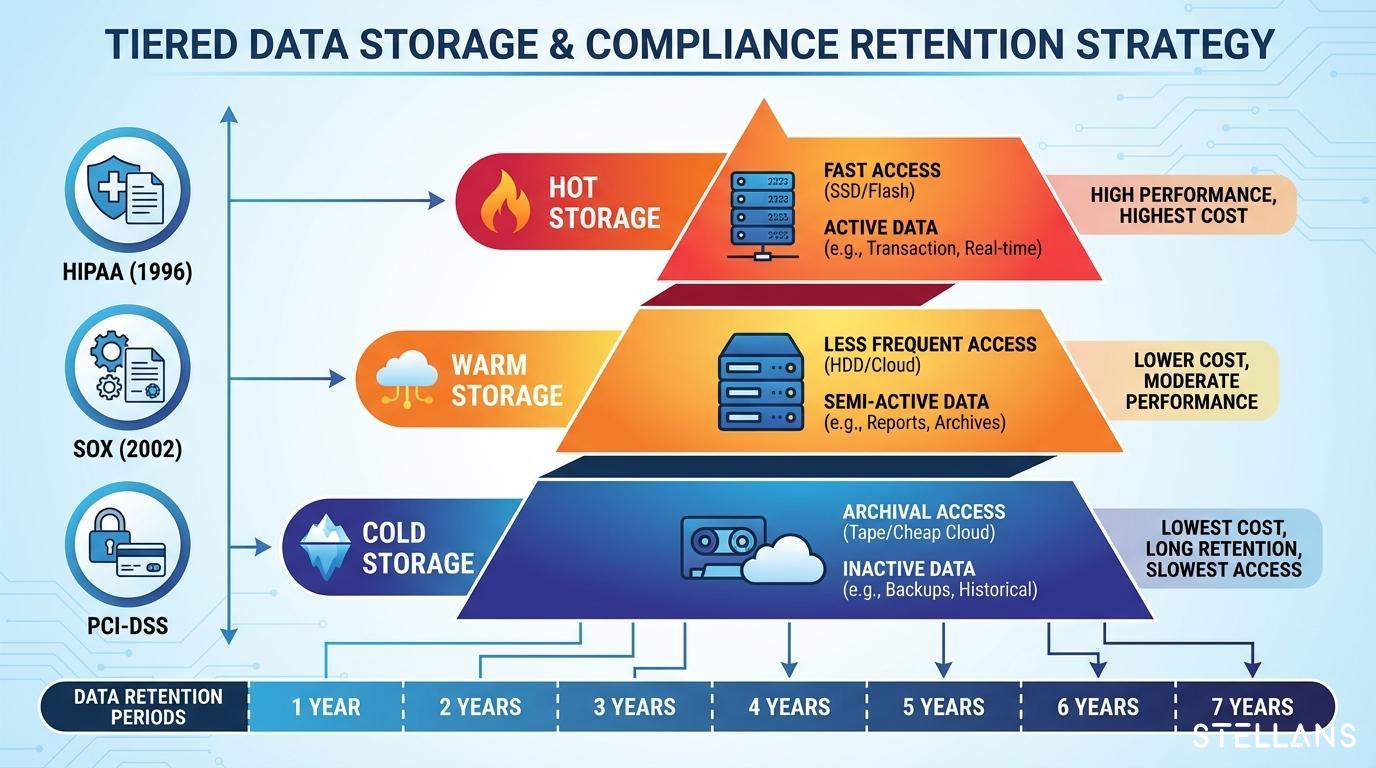
Effective log retention balances compliance requirements and storage costs. A tiered storage strategy maintains accessibility for recent logs while controlling costs for older data.

Tiered Storage Strategy: Hot, Warm, and Cold

Using tiered storage places logs in different classes based on access frequency and regulatory needs:

Storage Tier Use Case Typical Retention Relative Cost
Hot (Immediate Access) Active analysis, real-time queries 0-30 days Highest
Warm (Accessible) Compliance queries, audit requests 31-365 days Medium
Cold (Archive) Long-term regulatory retention 1-7 years Lowest
External (S3/Blob) Extended archive, legal hold 7+ years Minimal

Automating Log Collection and Centralization

Manual log management causes gaps and inconsistencies. Automating log collection from all sources into a centralized repository ensures complete coverage and consistent retention application.

A recent healthcare client we partnered with cut storage costs by 40% while maintaining HIPAA compliance by keeping 90 days of logs in Snowflake for active analysis and archiving older data to S3 with Glacier storage class for the remaining five-plus years.

Balancing Compliance with Storage Costs

Storage costs accumulate quickly with large log volumes. Cost optimization includes:

Our team helps organizations model storage costs and build cost projections to justify retention decisions to finance, while maintaining compliance. Check our work on data integration with Snowflake for similar challenges.

Automating Log Purge and Archive Workflows

https://stellans.io/wp-content/uploads/2026/01/stellans2026-01-13T20_23_04.605Z.png

Manual retention management introduces human error and risk. Automated workflows archive and purge logs per policy without requiring manual intervention.

Building Automated Retention Policies

Automation needs clear rules on when logs move between storage tiers and when they are deleted. Document these rules and implement them programmatically.

Snowflake Tasks for Scheduled Log Management

Snowflake Tasks schedules SQL executions, ideal for automated archival. Example task archives query history data older than 90 days:

CREATE TASK audit_archive_task
  WAREHOUSE = compliance_wh
  SCHEDULE = 'USING CRON 0 0 * * * UTC'
AS
  INSERT INTO audit_archive_table
  SELECT * FROM SNOWFLAKE.ACCOUNT_USAGE.QUERY_HISTORY
  WHERE start_time < DATEADD(day, -90, CURRENT_DATE)
  AND start_time >= DATEADD(day, -91, CURRENT_DATE);

This task runs daily at midnight UTC, copying records that crossed the 90-day threshold into an archive table.

External Archive Integration (S3, Azure Blob)

For long-term retention, Snowflake’s External Tables and COPY commands integrate with cloud storage. Organizations can:

For more on Snowflake automation, see our guide on automating Snowflake warehouse scaling with resource monitors.

Creating a Defensible Log Retention Policy

A documented retention policy protects your organization during audits by showing intentional, compliant data management.

Essential Policy Components

Your log retention policy should include:

Documentation for Audit Readiness

Auditors expect a systematic log management approach. Maintain documentation, including:

Multi-Framework Compliance Mapping

Organizations under multiple regulations should create a compliance map showing how their retention policy meets each framework. This simplifies audits and identifies coverage gaps.

How Stellans Helps Organizations Navigate Log Retention Compliance

Compliant log retention requires regulatory and data platform expertise. Stellans works with compliance officers and platform teams to design retention strategies that satisfy auditors without breaking budgets.

Data Compliance Advisory Services

Our governance services help:

We bring hands-on experience supporting enterprises in healthcare, finance, and tech navigate complex compliance landscapes. Our approach blends regulatory expertise and data engineering to deliver real-world, effective solutions.

Key Takeaways

Audit log retention compliance requires structured approaches addressing regulations and operations:

Ready to build a compliant retention strategy for your data platform? Contact Stellans to discuss how to navigate regulations while optimizing storage costs.

Frequently Asked Questions

How long should audit logs be retained for HIPAA compliance?

HIPAA requires covered entities and business associates to retain audit logs related to protected health information (PHI) for a minimum of six years from the date of creation or last effective date. This includes documentation of security policies, procedures, and system activity records that demonstrate compliance with the Security Rule.

What are the SOX audit log retention requirements?

The Sarbanes-Oxley Act (SOX) requires organizations to retain audit records relevant to financial reporting for seven years after the auditor concludes the audit or review of financial statements. This applies to logs documenting access to financial systems and any records that support the integrity of financial data.

How long does Snowflake retain audit logs by default?

Snowflake’s ACCOUNT_USAGE views retain historical data for 1 year (365 days). For longer retention periods required by regulations like SOX (7 years) or HIPAA (6 years), organizations must export and archive logs to external storage before they age out of the native views.

What is the PCI-DSS 4.0 log retention requirement?

PCI-DSS 4.0 requires organizations to retain audit trail logs for at least 12 months, with at least 3 months immediately available for analysis. Logs must capture all access to cardholder data environments, authentication attempts, and actions by privileged users.

How do GDPR data minimization requirements affect log retention?

GDPR requires that personal data, including data in logs, should not be kept longer than necessary for the purposes for which it was collected. Organizations must document their justification for retention periods and balance security logging needs against minimization principles. There is no specific retention period mandated by GDPR.

Article By:

Mikalai Mikhnikau

VP of Analytics

Related Posts

    Get a Free Data Audit

    * You can attach up to 3 files, each up to 3MB, in doc, docx, pdf, ppt, or pptx format.