Data Mesh Implementation: Pragmatic Guide for Non-Unicorns

13 minutes to read
Get free consultation


For years, modern data architecture has been dominated by the stories of tech unicorns. Companies with infinite engineering budgets and armies of software developers have championed radical new frameworks. However, standard mid-market and enterprise organizations operate in a different reality. Chief Data Officers and Enterprise Architects achieve greater success by preserving existing infrastructure rather than replacing it overnight to follow a theoretical trend. You need a data mesh implementation that works alongside your legacy systems, existing business intelligence workflows, and current engineering staff.

Our mission at Stellans is simple: we build scalable systems, applications, and infrastructure that fuel growth and innovation. We view data mesh as an evolutionary operating model rather than a strict ideological doctrine. The reality of transitioning to a decentralized data architecture requires a careful, hybrid approach. It requires empowering individual business units while maintaining strong central guardrails.

This guide provides a practical blueprint for non-unicorn companies. We will unpack how to navigate the shift toward domain data ownership, explain the crucial role of a central data platform team, and detail a phased implementation roadmap. Our goal is your growth: we work with you to unlock data potential through a pragmatic, step-by-step technological evolution.

Why Traditional Data Teams Become Data Bottlenecks

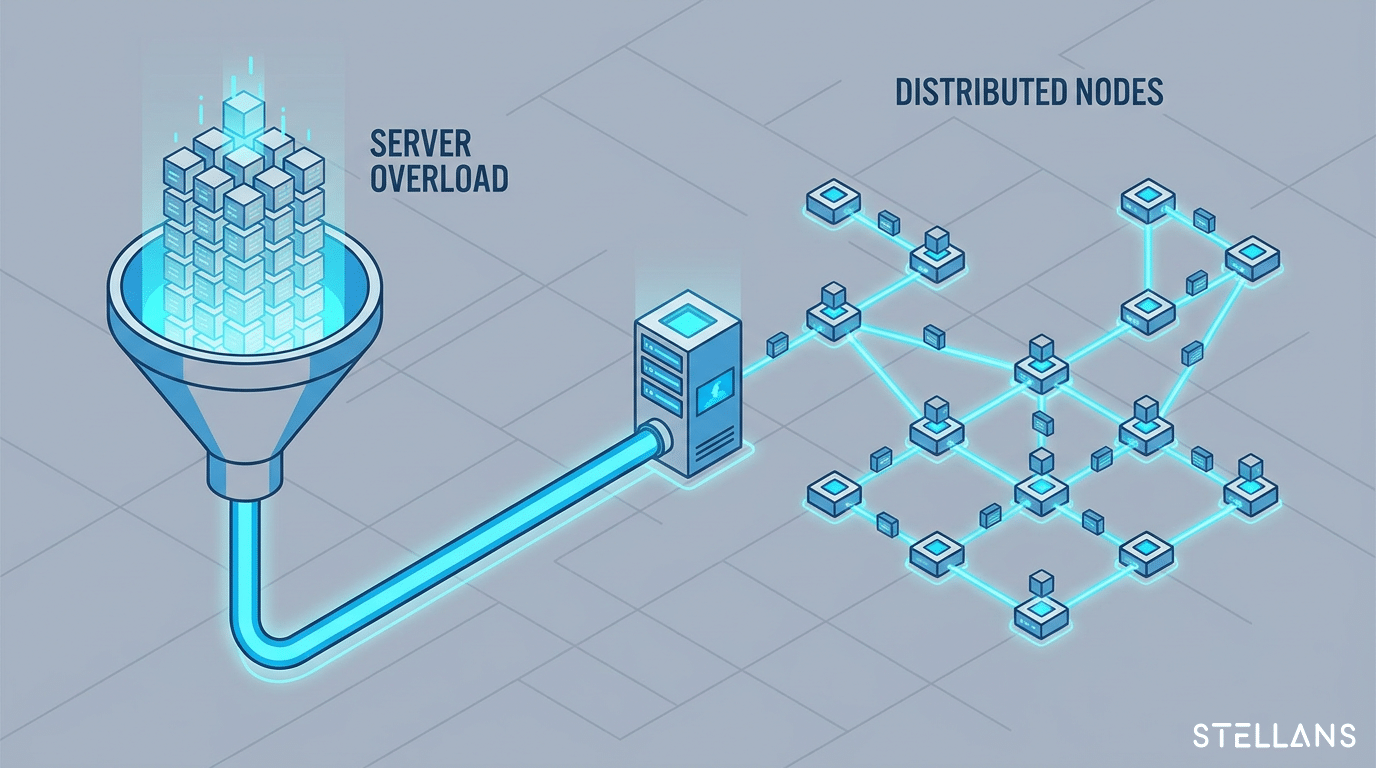
The traditional approach to enterprise data relies heavily on centralized monoliths. For decades, organizations have funneled every piece of information through a centralized data warehouse or data lake. In this setup, a single, highly specialized data engineering team manages the entire pipeline lifecycle: ingestion, transformation, storage, and publishing.

Initially, this centralized model makes sense. It centralizes control and creates a single source of truth. However, as the organization grows, the cracks in this foundation quickly become apparent.

Distributing responsibilities allows modern teams to scale proportionally when data volume and business demands increase. Otherwise, centralized teams become the ultimate data bottleneck. Business analysts across marketing, finance, and supply chain domains generate endless requests for new dashboards, custom integrations, and data reports. Domain teams possess the deep, domain-specific business context required to avoid the slow pass-through phase common in centralized requests. They spend cycles trying to understand the nuanced meaning of a “churned customer” for the marketing team while simultaneously trying to decipher supply chain logistics metrics.

Gaining domain context eliminates collaboration friction. When context is missing, tickets pile up in the backlog. Delivery speeds plummet. The business units experience delays in receiving critical intelligence, which stifles data-driven decision-making. Clients report that monolithic data pipelines inevitably function like a congested highway: passing volume relies entirely on the number of available lanes.

Furthermore, traditional centralized architectures mask data quality issues. When a pipeline breaks, the central engineering team is responsible for fixing it, regardless of holding ownership of the source system that caused the error. This disconnect strips accountability from the actual data producers. Organizations unlock speed and reliability by rethinking ownership and architecture to overcome these scaling challenges.

What is Data Mesh? Principles Translated for the Enterprise

If centralized data management represents the bottleneck, data mesh is the framework designed to clear it. Data mesh is an organizational and architectural paradigm shift that treats data as a decentralized product owned by business domains, rather than merely a centralized byproduct.

Adopting core data mesh principles brings massive value to standard enterprises. The key is translating these high-level principles into actionable operations that fit your existing business structure. Data mesh stands on four foundational pillars.

Domain-Oriented Decentralized Data Ownership

The first principle shifts accountability directly to the business units that generate the data. In a centralized model, the engineering team owns the data pipeline. In a data mesh, the marketing team owns marketing data, and the financial team owns finance data.

This concept of domain-oriented decentralized data ownership ensures that the people who understand the data best are the ones responsible for its accuracy and availability. Domain teams evolve into active publishers, bypassing the wait in a ticketing queue. This operational shift removes the central engineering bottleneck and gives domains the autonomy to model their data according to their specific operational realities. At Stellans, we find that moving ownership to the domain level drastically reduces miscommunication and improves overall data quality.

Data as a Product Concept

When business domains handle their own data, they elevate that data to meet the rigorous standards of a consumer-facing product.

The “Data as a Product” concept requires domain teams to produce data assets that are discoverable, addressable, trustworthy, and secure. A data product is a self-contained node that includes the data itself, the code required to transform it, and the underlying metadata. Internal consumers (other departments or executives) should be able to “shop” for these data products in an internal data catalog. Treating data like a reliable internal asset eliminates the risk of siloed, undocumented spreadsheets. Every data product has a defined lifecycle, service level agreements, and an assigned Data Product Owner.

Self-Serve Data Infrastructure as a Platform

Combining decentralization with robust enablement guarantees success. Providing robust self-serve data infrastructure allows marketing analysts and HR directors to act immediately, rather than building from scratch. This is where the self-serve data infrastructure principle becomes crucial.

The organization must provide a unified platform that lowers the barrier to entry. This platform offers standardized tools for data storage, orchestration, and access management. Instead of writing custom deployment scripts, a domain team can use a self-service portal to provision a data lakehouse environment or initiate a reliable ETL pipeline with just a few clicks. The self-serve infrastructure empowers domains to act independently using powerful tools, eliminating the need for deep data engineering expertise.

Federated Computational Governance

Federated computational governance provides elegant structure when multiple domains create independent data products.

Federated governance involves representatives from all domains, alongside security and compliance experts, collaborating to define enterprise-wide data policies. “Computational” means that these policies are embedded directly into the self-serve platform as code. The infrastructure automatically enforces standards, upgrading from manual compliance reviews. If a domain attempts to publish a data product that exposes personally identifiable information without proper masking, the automated governance protocols proactively secure deployments by blocking it. This ensures compliance while maintaining exceptional speed.

The Pragmatic Approach: Phased Data Mesh Implementation

Standard enterprises benefit from sustained, continuous operations while gradually evolving their architecture. Adopting a decentralized data architecture relies heavily on a phased, evolutionary roadmap that starts small and proves value incrementally.

Our pragmatic implementation strategy depends on careful planning. Here is the step-by-step approach we use when delivering our [consulting on digital transformation] services.

Step 1: Define Your First Domain and Pilot Data Products

Focusing on specific, achievable goals yields the best results. A successful data mesh implementation begins with a single, high-impact business domain. Choose a pilot domain that suffers from existing data bottlenecks but has strong leadership and clear business use cases. Marketing or supply chain analytics are often excellent starting points.

Once you select the pilot domain, identify two or three critical data products to build. These should be datasets that offer immediate business value: for example, a unified ‘customer 30-day engagement’ data product. Dedicate resources to help this domain take full ownership of their data lifecycle. By isolating the initial implementation to a single business unit, you create a controlled environment to test workflows, iron out technical hurdles, and document best practices.

Step 2: Establish Data Contracts and Quality Baselines

Trust drives the success of a data mesh. Realizing decentralized ownership means establishing strict guidelines on how data products interact. You achieve this by implementing data contracts.

Data contracts are formal agreements between the data producers (the domain team) and data consumers. These contracts specify the schema, data quality expectations, update frequencies, and service level agreements (SLAs). For your pilot domain, define what constitutes “acceptable quality” for their new data products. Implement automated testing to validate the data against the contract before it reaches the data catalog. Establishing these baseline contracts early ensures that as you scale, internal consumers can confidently rely on the products published by other domains.

Step 3: Deploy the Self-Serve Platform Layer

Accelerating your pilot success means prioritizing friction removal. Begin building the self-serve data infrastructure in parallel with your pilot domain’s development. Pragmatic enterprises rapidly assemble this platform by integrating existing commercial off-the-shelf tools.

Leverage your existing data lakehouse or cloud warehouses. The goal is to create a seamless layer where the pilot domain can easily ingest data, apply transformations, and publish the results. Implement straightforward orchestration tools and a centralized data catalog so other teams can easily discover what the pilot domain produces. This platform layer requires continuous refinement based on feedback from the pilot domain users.

Step 4: Scale Incrementally and Refine Organizational Design

Scaling becomes a natural evolution once your pilot domain successfully publishes its first set of data products and internal consumers validate the value. You use the lessons learned from the pilot to onboard a second and third domain.

As you expand the mesh, the organizational design must evolve. Introduce new roles, such as Data Product Owners, within the business units. Continue to automate governance checks within the self-serve platform. Scaling incrementally allows the organization to build cultural momentum. Success breeds success: when other departments see the agility achieved by the pilot domain, they become eager to adopt the decentralized model.

The Essential Role of the Central Data Platform Team

Decentralized architecture actually elevates the central data team into a highly critical enablement role. Decentralization requires incredibly strong central enablement. The traditional data team evolves directly into the central data platform team.

The role of the central data platform team is strictly focused on enablement and infrastructure, ensuring business units have everything they need to build specific business data pipelines. They act as the architects of the self-serve platform. Their primary responsibility is to provide the reliable, scalable tools that domains need to manage their data products autonomously.

We view the central team as a product development squad where their customers are the internal domain teams. Day-to-day, this team provisions cloud environments, maintains the enterprise data catalog, and ensures network security. They select and integrate the orchestration engines, ensuring that a financial analyst can deploy a scheduled data transformation pipeline with minimal friction.

Another critical function of the central platform team is keeping the data mesh flawlessly synchronized. They achieve this by setting strict interoperability standards. By mandating a universal schema registry or enforcing uniform identity and access management protocols, the central team guarantees that a data product created by the HR department can seamlessly integrate with a data product created by the finance department.

Furthermore, the central data platform team manages the underlying computational governance rules. They collaborate with legal and compliance departments to translate complex business regulations into executable code within the infrastructure. In essence, the central team provides the robust tracks upon which the domain trains run, ensuring speed, security, and enterprise alignment.

Federated Data Governance in a Decentralized Architecture

Governance provides peace of mind for Enterprise Architects considering a data mesh. A proactive approach to compliance guarantees HIPAA or GDPR adherence when varying business units control their own data.

Modern data leaders turn to federated computational governance. Implementing a federated data governance structure balances domain autonomy with rigorous enterprise compliance. The key is separating policy creation from policy enforcement.

In a federated model, governance is a collaborative effort. A federated council consists of data stewards from individual domains, alongside central security officers and legal experts. This council defines the global policies that every localized data product must follow. They determine the acceptable encryption standards, define data retention lifecycles, and categorize sensitivity levels across the entire organization.

Once the council defines these rules, the central platform team implements them as policy-as-code within the self-serve infrastructure. This automated enforcement provides a safety net. If a domain team attempts to publish a new data product containing unencrypted credit card numbers, the self-serve deployment pipeline automatically rejects the task.

This infrastructure-led approach allows domains to move quickly. Teams bypass manual governance review tickets because the rules are inherently baked into the tools they use. Our [data governance foundations] services consistently emphasize that automating compliance directly at the platform layer reduces risk while maximizing agility. The system handles the regulations, leaving domain teams free to focus on data utilization and core business growth. Clients report up to 40% faster insight generation post-implementation precisely because the compliance friction is automated away.

Overcoming Real-World Data Mesh Challenges

While a phased approach mitigates risk, non-unicorn companies will encounter distinct opportunities for growth when implementing a data mesh. The most significant transition is highly cultural, rather than purely technological.

Moving toward localized domain ownership inspires a massive shift in mindset. Business unit leaders elevate their practices to managing data as a formal product instead of passively fetching it from IT. Achieving cultural buy-in thrives on comprehensive training, vocal executive sponsorship, and an alignment of incentives. You must ensure that Data Product Owners are recognized and rewarded for the quality of their datasets.

Integrating with legacy architectures presents a strong opportunity to systematically modernize. Many enterprise environments rely on deeply entrenched, tightly coupled data warehouses and traditional ETL pipelines. The pragmatic enterprise preserves value by wrapping legacy systems into their own specific data domains, ensuring a smooth transition. You systematically migrate specific reporting workloads piece by piece, running the new self-serve pipelines in parallel with the legacy systems until stability is proven.

Building and maintaining this transition requires a robust technological foundation. Partnering with experts who specialize in [scalable engineering infrastructure] ensures your underlying systems can handle both legacy integration and modern decentralized demands. It requires a delicate balance of careful code management and continuous automated testing to bridge the gap between old and new.

Conclusion: Taking Your First Step Toward a Data Mesh

Moving toward a pragmatic data mesh implementation represents a deeply rewarding evolution for scaling modern businesses. By addressing the data bottleneck through decentralized domain ownership, adopting a data-as-a-product mindset, and empowering teams via a robust central data platform team, you can unlock unparalleled organizational agility. The journey succeeds on deliberate, phased strategies supported by automated, federated governance, operating smoothly without unicorn-level engineering budgets.

We work with you to simplify complex transitions. Stellans empowers organizations by ensuring tech choices directly drive tangible business goals. Take the next step toward streamlining your analytics strategy and establishing a highly capable, domain-driven architecture. Explore how our strategic Consulting Solutions can guide your digital transformation journey today.

Frequently Asked Questions

What is a data mesh example? A practical example involves a retail company where the supply chain domain manages inventory data sets, and the marketing domain manages campaign engagement metrics. Each domain independently cleans, models, and publishes their data as a “product” on an internal company catalog. When executives need to forecast sales, they seamlessly combine the supply chain inventory product with the marketing engagement product, confident in the quality of both while utilizing robust self-serve tools to assemble the report.

What problems does data mesh solve? Data mesh structurally resolves the prevalent issue of centralized data team bottlenecks. In traditional monolith architectures, a single engineering team struggles to manage scaling data pipelines across different departments, leading to huge ticketing backlogs, poor data quality, and slow delivery times. Decentralizing ownership directly to the business domains systematically eliminates this bottleneck and accelerates data-driven decision-making.

Can you implement data mesh incrementally? Yes. In fact, an incremental approach is heavily recommended for standard enterprise companies. You can start by establishing a self-serve platform layer and designating a single, high-impact business domain, like marketing or finance, to pilot the process. Once they successfully publish and manage autonomous data products, you can systematically scale the framework out to other operational units.

What is the role of a central data platform team? The central data platform team focuses entirely on powerful enablement. They design, deploy, and maintain the underlying self-serve infrastructure to support the business directly. They manage access controls, maintain the enterprise data catalog, and embed automated governance checks, allowing domain users to build and publish secure data products using highly intuitive tools.

References

  1. TDWI: Domain-Oriented Decentralized Data Ownership
  2. Harvard ADS / arXiv: Federated Data Governance Structure
  3. Wikipedia: Core Data Mesh Principles

Article By:

https://stellans.io/wp-content/uploads/2026/01/leadership-2.jpg
Anton Malyshev

Co-founder

Related Posts

    Get a Free Data Audit

    * You can attach up to 3 files, each up to 3MB, in doc, docx, pdf, ppt, or pptx format.