Demystifying Marketing Mix Modeling (MMM) in the Privacy Era

13 minutes to read
Get free consultation


The end of the third-party cookie is officially upon us, creating an unprecedented data blackout for modern marketers. If you’re panicking about lost ad tracking while your executive team demands pinpoint marketing ROI analysis, you’re not alone. With individual tracking methods disappearing across all major platforms, what is the clear path forward for your business?

Marketing mix modeling is returning stronger than ever, offering a definitive capability for the cookieless attribution era. We build bespoke data pipelines to help you navigate this transition, systematically turning data privacy challenges into a clear market advantage. Our ultimate goal is to empower your precise budget allocation and clear revenue forecasting.

Why MMM Is Making a Comeback in a Cookieless World

The 2010s were all about behavioral hyper-targeting, with marketers relying heavily on tracking individual user clicks across the internet. That era of granular digital surveillance is ending as we witness a massive industry shift back to aggregate modeling.

Enterprises are adapting quickly to this new, strictly regulated reality. We are seeing a 55% year-over-year surge in MMM budgets among top brands because forward-thinking CMOs recognize the absolute need for resilient measurement strategies. You can no longer rely on fragile user-level tracking data. The digital ecosystem has become too restrictive and volatile.

Cookieless attribution demands a holistic, strategic perspective, and marketing mix modeling provides the exact top-level view securely. It precisely measures the aggregate impact of your entire marketing orchestra without depending on invasive tracking pixels. This advanced statistical method respects user privacy while delivering highly actionable insights. We believe aggregate models are the ultimate future-proof strategy, empowering you to make budget decisions without fearing the next privacy update.

Why Tracking Pixels Are Failing

Marketers are losing their primary historical data sources as major technology companies prioritize consumer privacy. Apple introduced App Tracking Transparency with iOS 14.5, and subsequent updates like iOS 17 actively stripped tracking parameters from URLs. The upcoming Android Privacy Sandbox is following the same path.

These platform changes are devastating for traditional tracking methodologies, permanently blocking up to 85% of tracking pixels across mobile ecosystems. The negative impact on your overall data visibility is tremendous. Furthermore, regional governments are strictly enforcing broad Privacy Regulations (CCPA, GDPR), which severely restrict user-level data collection. Compliance is no longer optional for major modern enterprises.

Web browsers are also aggressively restricting third-party tracking capabilities. We are navigating significant, ongoing shifts in web privacy, and third-party cookies are rapidly losing their measurement dominance. You simply cannot trust basic pixel-based tracking systems anymore. The “lost ad tracking” pain is real for marketing teams, and we help you overcome this challenge seamlessly. Our data strategies ensure you maintain high visibility over your spending.

Understanding Attribution: Top-Down vs Bottom-Up

You need to understand the fundamental differences in attribution methods. The marketing industry is actively shifting from bottom-up to top-down analytical approaches, and this strategic shift is crucial for your future success.

What Is Bottom-Up Attribution?

Bottom-up attribution focuses on the individual consumer journey. Multi-Touch Attribution (MTA) is the most common bottom-up method, attempting to track a single user across multiple touchpoints before a final purchase.

MTA relies heavily on browser cookies and tracking pixels, but continuous privacy updates are breaking these delicate mechanisms. Bottom-up models are losing their functional accuracy quickly and now fail to capture the true cross-channel marketing impact. Your current bottom-up reports are likely missing critical revenue data, leading to a dangerously unclear ROI. You cannot confidently formulate a growth strategy based on broken data.

What Is Top-Down Attribution?

Top-down attribution takes a comprehensive, macro-level perspective. It evaluates your overall marketing spend alongside your overall business outcomes. Marketing mix modeling is the pinnacle of this top-down attribution philosophy.

This analytical approach is inherently privacy-safe because it never attempts to track individual user behavior. Instead, it analyzes massive aggregate consumer trends over extended periods. Top-down attribution successfully reveals the true financial drivers of your total revenue. We use this method to build a well-oiled data machine, providing a reliable foundation for your global marketing strategy over time.

Essential Data Requirements for Accurate MMM

A successful predictive model requires high-quality internal data. The data requirements for MMM are rigorous but entirely achievable, and we guide you through the complete, end-to-end data collection process. Our custom-built data pipeline acts as a highway to ensure smooth, continuous information flow.

First-Party Data and Clean Rooms

You must prioritize harvesting your privately owned data. First-Party Data is your most valuable digital asset today, including your internal CRM records and direct, historically validated transaction histories.

We highly recommend using modern Data Clean Rooms, which allow for anonymous data matching. They rigorously protect individual consumer privacy while enabling deep, aggregate analysis. We help you integrate these advanced software tools seamlessly into your infrastructure so your robust first-party data becomes your greatest competitive advantage. This strategic shift reduces your reliance on external marketing platforms.

Aggregated vs User-Level Data

Modern marketing mix modeling thrives on robust aggregated data. You do not need granular, legally challenging user-level data. Instead, you need consistent, weekly aggregate historical data points.

We typically require two to three years of pristine historical data to help the analytical model understand complex seasonal patterns. You must accurately categorize and include your total media spend across all marketing channels. You also need to factor in broad, uncontrollable external elements like seasonality and macro-economic factors, which are critical modeling inputs. We expertly consolidate all these varied, disparate data sources for you, transforming them into a clean, actionable dataset for accurate modeling.

Introduction to Bayesian MMM

We strategically leverage advanced statistical science to demystify your marketing data. Hierarchical Bayesian Models are the proven, modern statistical gold standard, and we act as your specialized technical translator for these complex concepts.

Advantages Over Traditional Regression

Traditional regression models are often too rigid and inflexible, struggling with complex or partially missing enterprise datasets. Bayesian MMM handles uncertain or noisy data much more gracefully and allows us to incorporate your prior expert business knowledge.

This inherent statistical flexibility is essential for solving an unclear ROI. Bayesian methods generate rich, comprehensive probability distributions rather than solitary, limited numbers. This means we can precisely quantify the confidence of our analytical insights and deliver realistic ranges for your expected marketing financial returns. Your executive budgeting decisions become safer and more predictable, allowing you to optimize your broader business strategy with clear mathematical backing.

Modeling Adstock and Saturation Effects

Real-world advertising impact is rarely immediate. The conceptual model of Adstock measures this delayed marketing effect. For example, a television commercial might influence a consumer to purchase several weeks later.

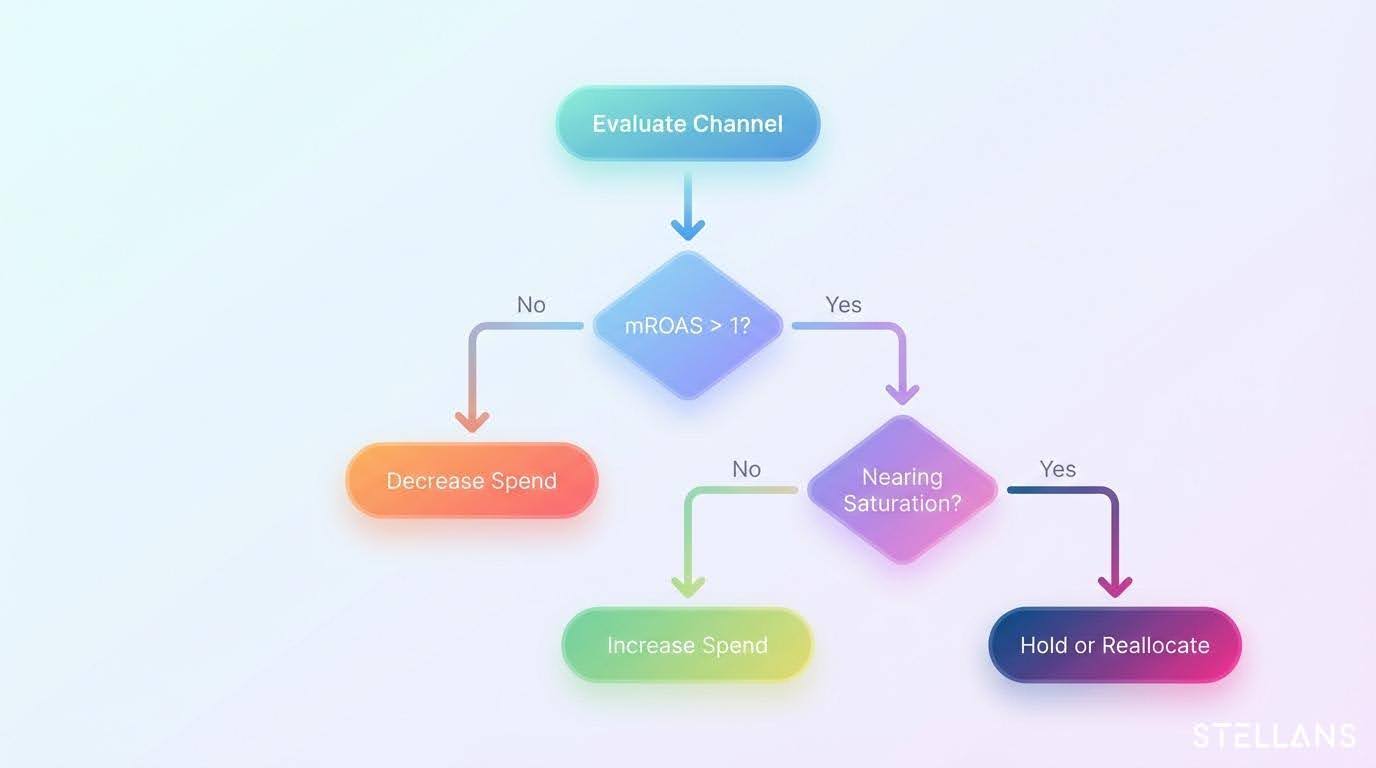
Adstock mathematically captures this lingering, valuable consumer brand awareness. Saturation Effects dynamically measure the diminishing returns on your excessive ad spend. Think of your target market as a dry sponge. At first, it readily absorbs water, but eventually, it becomes saturated. Adding more water doesn’t help. Similarly, adding more marketing spend to a highly saturated digital channel wastes money. We accurately model these critical saturation effects to save your operational budget.

Marketing ROI Analysis & Budget Allocation Insights

You need to know where to invest your next marketing dollar. Bayesian MMM transforms your traditional, outdated marketing ROI analysis practices. We provide highly actionable, data-driven budget allocation insights consistently over time.

Our sophisticated predictive models allow for rigorous financial scenario planning. You can digitally simulate different budget distributions quickly and easily. We forecast the probable future revenue outcomes for every distinct financial scenario, removing the dangerous emotional guesswork from your financial planning.

Furthermore, you can actively identify media channels that drive true systemic incrementality. We ensure you only pay for ads that genuinely generate new, unique business. We build these powerful forecasting capabilities directly into your internal corporate data systems, giving you continuous, proactive financial control over your entire marketing budget. We work closely with you to unlock your full enterprise data potential.

The Stellans Approach: Custom AI & DataOps Implementation

Many data agencies push rigid, out-of-the-box SaaS tools that almost always lead to frustrating, costly vendor lock-in. We believe a true modern MMM is a highly customized, internally owned data pipeline.

We engineer completely bespoke technical solutions for your specific business needs. Our dedicated technical team flawlessly integrates powerful predictive AI directly into your existing digital infrastructure. This modern engineering approach offers unparalleled data transparency and total system ownership. We empower you to own your strategic corporate analytics completely and permanently, so you are never restricted by a secretive, external software vendor again.

Our expert engineering team specializes in building scalable data engineering pipelines. We ensure your critical business data flows perfectly into your customized statistical models. We also develop custom AI solution frameworks to automate these complex marketing insights. We provide advanced marketing analytics services that evolve with your rapidly growing business, turning complex privacy compliance into your strongest operational asset.

Build Your Future-Proof Analytics Engine

Stop guessing your actual marketing ROI. It is time to build a scalable, future-proof corporate analytics engine. We are ready to empower your entire organization. Collaborate with our data experts right now to get started. Let us transform your complex data privacy challenge into measurable business success.

Frequently Asked Questions

What is cookieless attribution?
Cookieless attribution measures complex marketing campaign performance without relying on browser cookies. It utilizes advanced, sophisticated mathematical models and privacy-compliant aggregate data. This comprehensive approach effectively solves the modern lost ad tracking dilemma.

Why is MTA failing in the privacy era?
MTA requires continuous, uninterrupted individual tracking across various external websites and mobile devices. Strict Privacy Regulations (CCPA, GDPR) and frequent OS updates block this granular tracking. The resulting fragmented data causes highly inaccurate bottom-up attribution reporting.

How does incrementality actually work with MMM?
Incrementality measures specific conversions that occurred strictly because of a viewed advertisement. It excludes baseline consumer conversions that would have happened naturally anyway. MMM mathematically identifies this true incremental lift across all uniquely connected marketing channels.

What are the critical data requirements for MMM?
Accurate MMM requires two to three full years of detailed weekly aggregate historical data. This dataset includes full media spend, total sales data, and relevant external macro factors. You explicitly do not need any individual, user-level behavioral tracking data.

References:

Article By:

https://stellans.io/wp-content/uploads/2026/01/1565080602204-1.jpeg
Zhenya Matus

Fractional CDO

Related Posts

    Get a Free Data Audit

    * You can attach up to 3 files, each up to 3MB, in doc, docx, pdf, ppt, or pptx format.