The market for EDM solutions is crowded and noisy. Most articles you’ll find are thinly veiled advertisements designed to promote a specific product. To make a sound decision, you need to cut through the marketing jargon and build a decision framework that is tailored to your unique business context and designed to mitigate risk.
This framework is not just a checklist; it’s a strategic tool. It forces you to define what success looks like before you ever see a product demo. It ensures that your technical requirements are directly tied to business outcomes and provides an objective lens through which to evaluate potential partners. Here’s how to build one.
Step 1: Define Your Business and Technical Requirements
Before you can evaluate vendors, you must first define your needs. This process starts with translating high-level business goals into specific technical capabilities. A failure to connect your technology requirements to tangible business outcomes is the number one reason why EDM projects fail to deliver ROI.
Map your strategic objectives to the specific EDM functionalities required to achieve them. For instance:
- Business Goal: Increase regulatory reporting speed by 30%.
- Technical Need: A robust Data Governance module with automated lineage tracking and a centralized policy management engine.
- Business Goal: Create a “single customer view” to improve cross-sell opportunities.
- Technical Need: A powerful Master Data Management (MDM) platform capable of consolidating customer records from a dozen different source systems.
- Business Goal: Reduce operational errors caused by poor data entry.
- Technical Need: An advanced Data Quality framework with real-time profiling, validation rules, and cleansing workflows.
- Business Goal: Empower business analysts to find their own data.
- Technical Need: A comprehensive Data Catalog with rich Metadata Management capabilities, including business glossaries and social curation features.
By starting with the “why,” you ensure your evaluation is focused on what truly matters. Your core checklist of features to consider should include: Data Governance, MDM, Data Quality, Metadata Management, and Data Cataloging.
Step 2: Score and Compare EDM Vendors Objectively
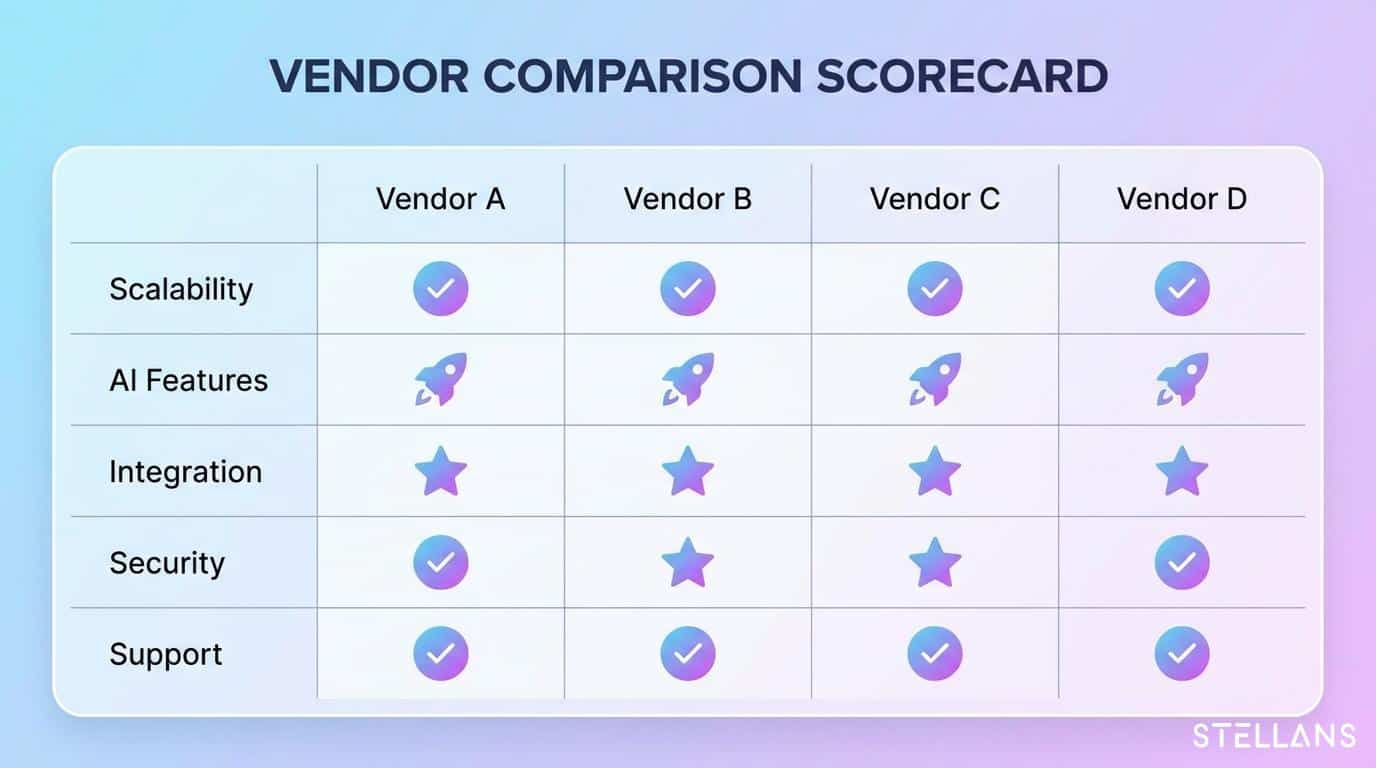
With your requirements defined, you can now build a vendor scorecard to compare potential solutions. This tool forces a structured, data-driven comparison and minimizes the influence of a flashy sales presentation.
Your scorecard should weigh criteria based on your specific priorities. For a company in a highly regulated industry, governance and security might be weighted most heavily. For a fast-growing digital native, scalability and integration may be paramount.
Here is a sample scorecard comparing a few major players in the EDM space. Note that ratings are illustrative; you should populate this with your own research from analyst reports, peer reviews, and proof-of-concept results.
Step 3: Analyze Total Cost of Ownership (TCO) Beyond the License Fee
The sticker price of an EDM platform is just the tip of the iceberg. A true TCO analysis must account for all the associated costs that you will incur over five years. Neglecting these “hidden” costs can blow your budget and jeopardize the entire project.
Be sure to factor in:
- Implementation & Integration Costs: This is often the largest hidden expense. It includes the vendor’s or a third-party consultant’s professional services fees, as well as the time of your internal engineering team.
- Infrastructure Costs: Will the solution run on your existing hardware, or will it require new servers or a significant cloud computing budget?
- Training & Change Management: Your team will need to be trained to use the new platform effectively. This includes formal training sessions and the “cost” of the initial productivity dip as users adapt.
- Maintenance & Support: What are the annual support fees? Do they increase over time? What level of support is included, and what are the costs for premium support?
- Personnel: Will you need to hire new specialists, such as data stewards or platform administrators, to manage the new solution?
A comprehensive TCO analysis provides a realistic picture of the long-term financial commitment and is critical for securing executive buy-in.