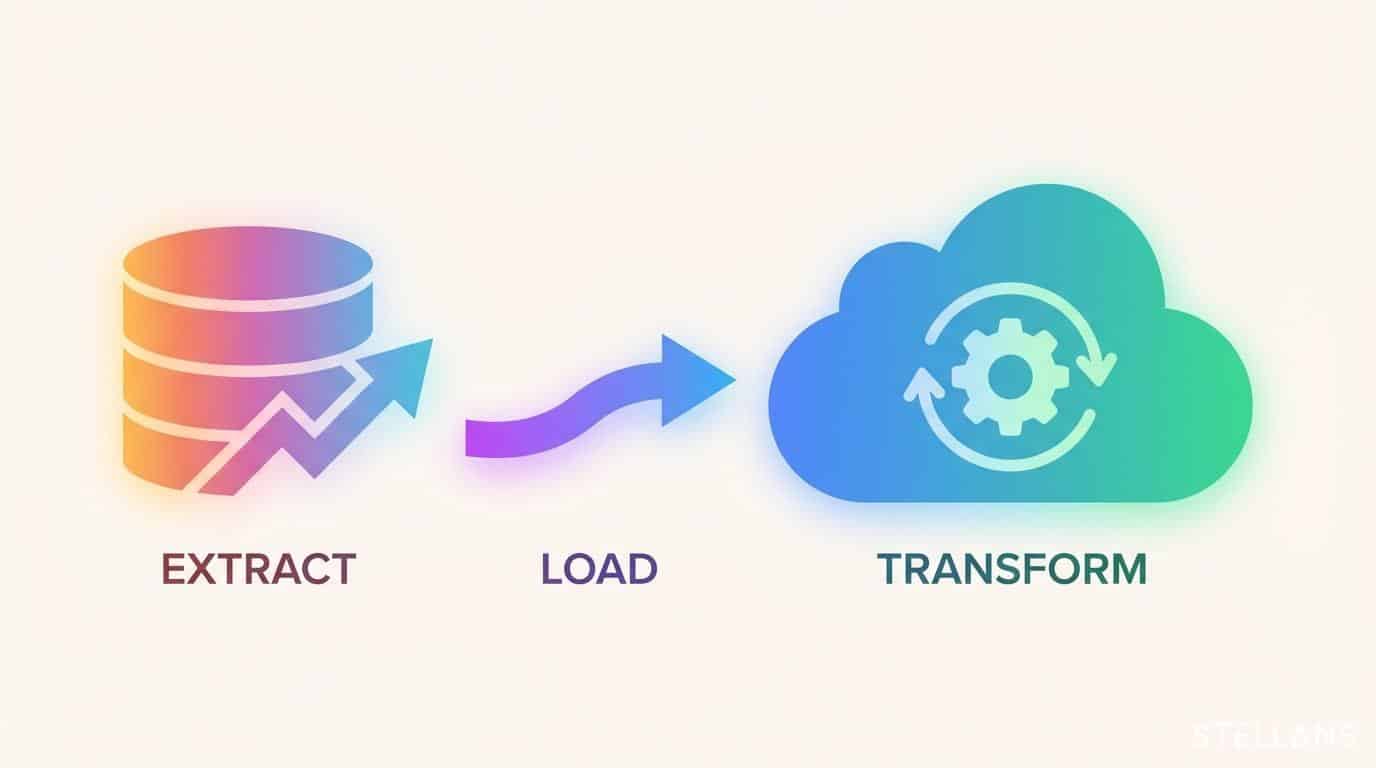
For decades, ETL was the undisputed champion of data integration. The high cost of on-premises data warehouse storage and compute meant that data had to be meticulously cleaned, shaped, and aggregated before loading. But the architectural constraints that made ETL a necessity have been obliterated by the cloud.
A Quick Refresher: What is Traditional ETL?
Traditional ETL is a linear, three-step process:
- Extract: Pull data from various source systems (databases, CRMs, ERPs, etc.).
- Transform: The extracted data is moved to a separate, dedicated processing server where complex transformations, business logic, and aggregations are applied. This is often the most resource-intensive and rigid step.
- Load: The transformed, analysis-ready data is loaded into the target data warehouse.
The primary limitation of this model in the cloud era is its rigidity and the “transformation bottleneck.” Scaling the transformation server is expensive and complex, and any change to the business logic requires significant re-engineering, slowing the delivery of insights.
The Modern Paradigm: Extract, Load, Transform (ELT)
The advent of powerful and cost-effective cloud data warehouses like Snowflake, Google BigQuery, and Amazon Redshift turned the old model on its head. These platforms separate storage from compute, allowing for near-infinite scalability on demand. This architectural shift gave rise to ELT.
The ELT workflow is simple yet revolutionary:
- Extract: Pull data from source systems.
- Load: Load the raw, unaltered data directly into the cloud data warehouse.
- Transform: Use the immense, scalable power of the data warehouse itself to run transformations on the data after it has been loaded.
This is a game-changer. By loading raw data first, you create a “single source of truth” that can be repurposed for countless use cases without having to re-ingest it. Transformations become flexible SQL queries (supercharged by tools like dbt) that can be easily modified, tested, and version-controlled. The benefits are clear: unparalleled flexibility, faster time to insights, and a future-proof foundation where all data is available for exploration.
The ETL vs. ELT Decision Framework
While ELT is the default choice for most modern cloud use cases, ETL still has a place. This framework helps you decide which pattern best fits your needs.
| Criteria |
Traditional ETL |
Modern ELT |
| Primary Use Case |
Small-scale datasets, strict compliance needs where PII cannot enter the warehouse untransformed, and legacy systems. |
Big data analytics, business intelligence, machine learning, and data science on cloud data warehouses. |
| Data Volume & Complexity |
Best for smaller, structured datasets. Struggles with high volume and semi-structured data (JSON, XML). |
Built for massive volumes and a wide variety of data types. Easily handles complex, nested data. |
| Data Freshness Requirements |
Slower, batch-oriented. Data can be hours or even days old. Difficult to achieve in real-time. |
Enables near real-time data ingestion. Transformations can be run on a frequent schedule for fresher insights. |
| Tools & Skills Required |
Requires specialized ETL developers and often proprietary, GUI-based tools (e.g., Informatica, SSIS). |
Leverages SQL, Python, and open standards. Empowers Analytics Engineers with tools like Fivetran, Airbyte, and dbt. |
| Cost Structure |
High upfront licensing and hardware costs for transformation servers. Predictable, but inflexible. |
Pay-as-you-go model for warehouse compute. Can be more cost-effective if managed well; it can be expensive if not optimized. |
| Winner for the Cloud |
Niche applications. |
The clear winner for scalability and flexibility. |
The verdict: For any organization building on a cloud data warehouse, the conversation starts with ELT. It is the new standard for building a scalable and agile data platform.