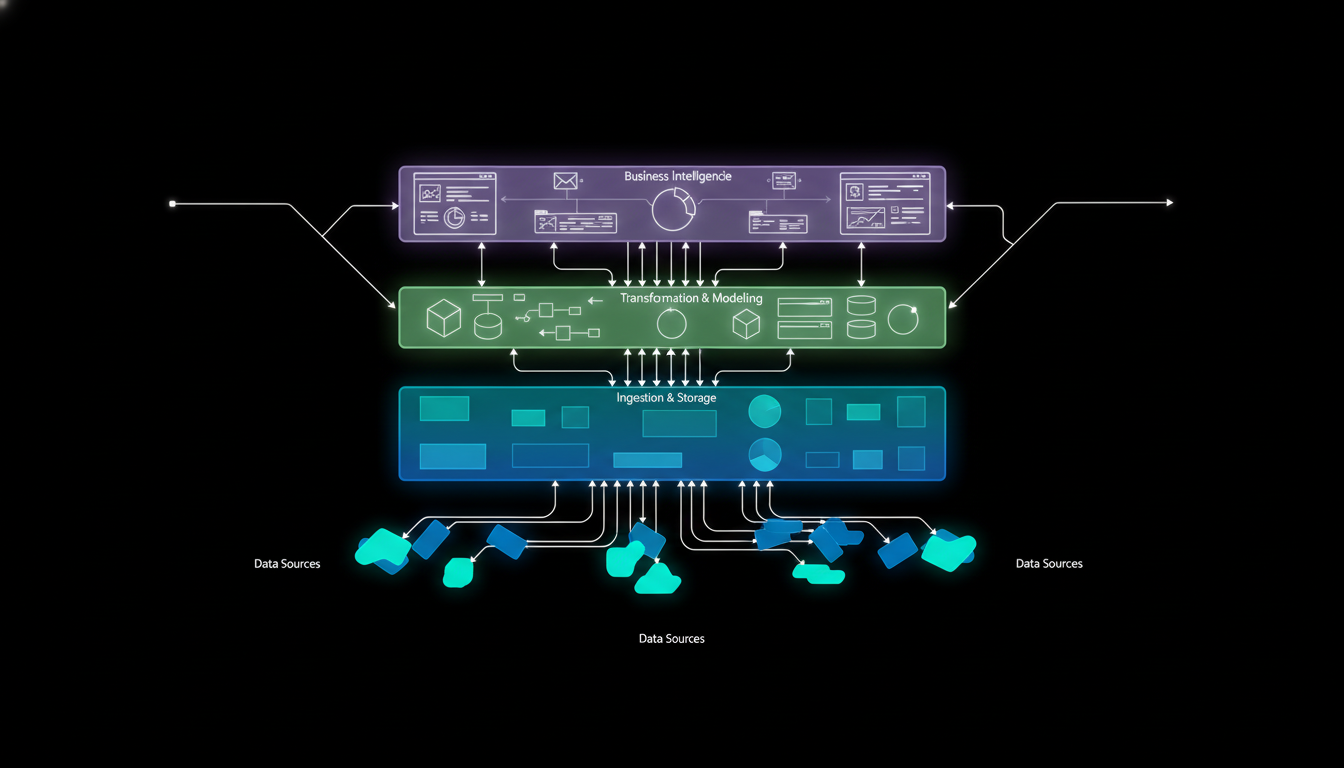
At Stellans, we recommend a proven five-layer architecture that transforms raw marketing data into a strategic asset. This blueprint is designed for clarity, scalability, and performance, so your marketing analytics can evolve with your business.
Layer 1: Data Ingestion
The first layer performs a critical function: reliably extracting raw data from all your marketing and sales sources and loading it into your data warehouse. Automation ensures the data remains fresh and complete.
Key Data Sources:
- Ad Platforms: Google Ads, Meta, TikTok, LinkedIn Ads
- CRM: Salesforce, HubSpot
- Web & App Analytics: Google Analytics, Mixpanel
- E-commerce Platforms: Shopify, Magento
Ingestion Tools & Methods:
We use modern, automated data ingestion tools like Fivetran to build robust pipelines. These tools handle API updates, schema changes, and scheduling, greatly reducing engineering overhead. For real-time data streams, such as website clickstream data, we leverage Snowflake’s native feature Snowpipe, which ingests data immediately on arrival.
Layer 2: Staging & Storage
After extraction, raw, unaltered data lands in a staging area within Snowflake. This layer serves as a foundational record of your source data. We store data exactly as received to support historical analysis, reprocessing if business logic evolves, and data science needs requiring untouched source data.
Snowflake’s design excels here. Its separation of storage and compute allows cost-effective storage of terabytes of historical data without compute costs until querying is needed. This makes it feasible to keep a complete historical record of every ad click, website visit, and customer interaction.
Layer 3: Transformation & Modeling
This “magic” layer converts raw data into business-ready insights. Transformation cleans, structures, and enriches data applying your business logic.
The Role of dbt:
We recommend using dbt (Data Build Tool) for all transformations. dbt codifies your business logic with SQL, making the process transparent, version-controlled, and testable. It turns data engineering into a reliable software discipline. With dbt, we join ad platform data with CRM data, standardize naming (e.g., treating “google” and “Google” identically), and build structured models.
Data Modeling for Marketing:
This layer implements dimensional modeling, like the star schema, organizing data into fact tables (metrics like cost, clicks, revenue) and dimension tables (attributes like campaign name, ad creative, customer demographics). This enables BI tools to query data efficiently and analysts to understand easily. The result is clean, analytics-ready tables that power reports—from Customer Lifetime Value calculations to multi-touch attribution models.
Layer 4: Governance & Security
Trust is data’s currency. Your entire system’s value collapses without stakeholder trust. The governance and security layer spans the full warehouse to guarantee accuracy, compliance, and security.
Key activities include:
- Data Quality Checks: Automated tests (with tools like dbt) identify nulls, duplicates, or unexpected data changes.
- Metadata Management: A data dictionary documents every table, column, and metric, ensuring shared understanding.
- Role-Based Access Control (RBAC): Snowflake’s granular security controls access to data, protecting sensitive customer information.
- Privacy Compliance: Designed to comply with GDPR, CCPA, and other privacy laws through anonymization and the right to be forgotten.
Layer 5: BI, Reporting & Activation
This final layer delivers the business value. Clean, modeled data in Snowflake connects to BI tools like Tableau, Power BI, or Looker, enabling stakeholders to explore data, analyze campaigns, and answer questions without data team delays.
Beyond reporting, this layer supports data activation. Using reverse ETL tools, enriched warehouse data flows back into marketing and sales platforms. For example, a list of high-value customers may be sent to Meta for lookalike targeting or lead scores pushed to Salesforce based on site behavior.