Multi-Touch Attribution: The Complete Guide to Models, Implementation & Privacy-Era Alternatives

12 minutes to read
Get free consultation

Introduction: The End of Attribution as We Knew It

The tools marketers have relied on for a decade are broken. The promise of clearly seeing a customer’s journey from first ad view to final purchase, the core of marketing attribution, is fading. For years, we measured success by connecting dots across the digital landscape, but the lines have gone blurry. My current model doesn’t capture the full customer journey, leaving blind spots in my strategy. I’m under pressure to justify every dollar of ad spend, but I lack confidence in our current ROI metrics.

Multi-touch attribution (MTA) was supposed to be the answer. It promised to give credit where credit was due, moving beyond the simplistic “last-click” model to illuminate the value of every blog post, social ad, and email along the path to conversion. It offered a sophisticated way to understand and optimize the intricate dance of modern marketing.

But the ground has shifted. A privacy quake, driven by regulations and platform changes, has created deep fissures in our tracking capabilities. The data signals we once took for granted are disappearing. To succeed today, marketers must evolve beyond traditional MTA alone. The future of measurement requires a hybrid, privacy-first philosophy that blends the best of tactical attribution with strategic, big-picture analysis. This guide provides the blueprint.

A Practical Comparison of Multi-Touch Attribution Models

Before we explore the solution, it’s crucial to understand the tools in the traditional MTA toolkit. Most are “rules-based” models, meaning they assign credit based on a predefined, unchangeable logic. Each tells a different story about your customer’s journey. Choosing one is not just a technical decision; it’s a strategic one that shapes your budget and focus.

H3: Linear Model: The Diplomat

The Linear model is the great equalizer. It spreads credit evenly across every single touchpoint in the customer’s journey. If a customer clicked a Facebook ad, read a blog post, received an email, and then made a purchase after a Google search, each of those four touchpoints receives exactly 25% of the credit.

H3: Time-Decay Model: The Closer

This model operates on the principle that the closer a touchpoint is to the conversion, the more influential it is. The touchpoint that occurs just before the sale gets the most credit, and the credit assigned to previous touchpoints decays exponentially further back in time they occurred.

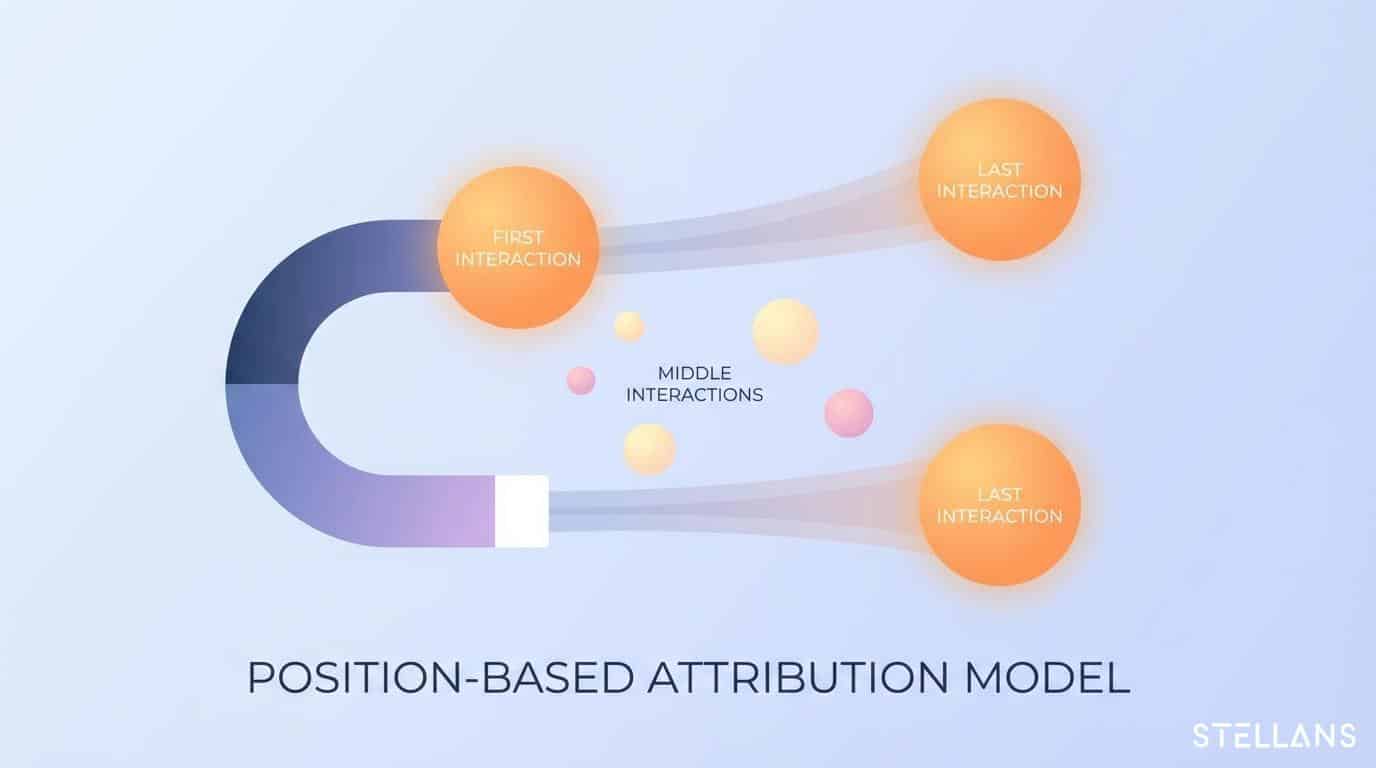
H3: Position-Based (U-Shaped) Model: The Opener & Closer

This model gives the most credit to the bookends of the journey: the first touch and the last touch. A common configuration assigns 40% of the credit to the first interaction, 40% to the final touchpoint (or the one that led to the conversion), and the remaining 20% is distributed among all the touches in between.

H3: Data-Driven Model: The AI Analyst

Unlike its rules-based counterparts, a data-driven attribution model uses machine learning to analyze all converting and non-converting paths to determine the actual contribution of each touchpoint. It looks for patterns in your specific historical data to build a custom model that assigns credit based on a channel’s observed impact on conversions.

Attribution Model Comparison Table

Model Best For Biggest Flaw Common Use Case
Linear Brands with long sales cycles where every touchpoint is considered equally important for nurturing. Treats a passive blog view and an active demo request as equal. Evaluating the overall health of a content marketing strategy.
Time-Decay Businesses with short sales cycles, like e-commerce flash sales or promotional campaigns. Devalues the initial brand discovery channels that started the journey. Optimizing bottom-of-funnel channels for a final conversion push.
Position-Based Marketers focused on both lead generation (first touch) and conversion optimization (last touch). The 40/20/40 credit split is arbitrary and may not reflect reality. Balancing the budget between top-of-funnel brand awareness and bottom-of-funnel direct response campaigns.
Data-Driven Mature organizations with high conversion volume and a dedicated data science resource. Highly susceptible to “garbage in, garbage out.” Signal loss from privacy changes can cripple its accuracy. Fine-tuning channel mix for large, complex digital advertising budgets.

The Privacy Quake: Why Your Attribution Model Is Failing

The models described above all share a dangerous vulnerability: they depend on collecting a clean, persistent stream of user-level data. That stream is drying up. What we are calling the “privacy quake” is a series of fundamental shifts that have broken the foundational mechanics of digital tracking. Apple’s ATT framework has decimated my mobile campaign visibility, and I don’t know how to measure true performance anymore.

H3: The Signal Loss from iOS 14+

With the introduction of the AppTrackingTransparency (ATT) framework, Apple gave users a simple choice: allow apps to track their activity across other companies’ apps and websites, or not. The overwhelming majority of users have chosen “not.” This severed the link between ad clicks within apps like Facebook, TikTok, or Pinterest and the eventual conversion events (like a purchase or sign-up) that happen on your website or in your app. For mobile-first businesses, this created an immediate and painful attribution gap.

H3: The Crumbling Cookie

For two decades, the third-party cookie was the connective tissue of the open web, allowing advertisers to follow users from site to site, measure ad frequency, and attribute conversions. But privacy concerns have rendered it obsolete. Browsers like Safari and Firefox have long blocked them, and the final nail in the coffin is Google’s third-party cookie deprecation in Chrome. Without this mechanism, tracking a user’s journey across different websites, for example, from a review site to a publisher’s article to your e-commerce store, becomes nearly impossible.

H3: The Wall of Consent

Regulations like GDPR and CCPA have given consumers legal rights over their data. Before you can drop a cookie or tracking pixel on a user’s browser, you often need their explicit and informed consent. This “consent wall” means that even if the technology to track works perfectly, you cannot legally use it for a significant portion of your audience who either ignore the banner or actively opt out. Your data set is inherently incomplete from the start.

The Solution: Unifying MTA with Marketing Mix Modeling (MMM)

If MTA is a bottom-up approach focusing on individual user paths, and those paths are now fragmented and incomplete, how do we move forward? The answer is not to abandon measurement but to augment it. The solution is to adopt a Unified Measurement Framework that marries the tactical, granular insights of MTA with the strategic, top-down view of Marketing Mix Modeling (MMM).

H3: What is Marketing Mix Modeling (MMM)? A Quick Primer

Marketing Mix Modeling is not new. It’s a statistical analysis technique that has been used for decades, long before the internet. MMM uses regression models to measure the impact of various marketing and non-marketing factors on a specific outcome, usually sales.

Instead of tracking individuals, MMM looks at aggregate data over time (e.g., weekly sales data). It correlates total sales with factors like:

Because it doesn’t rely on user-level tracking, MMM is almost completely immune to the privacy quake. It measures the overall, incremental impact of your channels, providing a durable, strategic view of performance.

H3: The Perfect Partnership: How MMM and MTA Work Together

The idea is not to replace MTA with MMM, but to use them as complementary tools. In our work with clients, we’ve seen this hybrid approach close the measurement gap and restore confidence in marketing ROI.

This Unified Measurement Framework creates a powerful feedback loop. MMM sets the budget, MTA optimizes the execution, and the results feed back into the next MMM cycle, creating a system of continuous improvement.

H4: A 4-Step Framework for Implementing a Hybrid Approach

Getting Implementation Right: From Data to Decisions

Putting this framework into practice requires a thoughtful approach to technology and data management. A common pitfall we help marketing leaders avoid is jumping to a tool before defining the strategy.

H3: Choosing Your Tech Stack Wisely

The market is flooded with “post-privacy” attribution tools. When evaluating them, focus on principles, not just features. Does the tool allow you to own your data, or does it lock it away in a black box? Can it integrate both marketing data and business data (like customer lifetime value) to create a more holistic model? Prioritize platforms that offer transparency, flexibility, and data ownership. This is a core component of our Marketing Analytics services.

H3: The Critical Role of Identity Resolution

With third-party cookies gone, the ability to stitch together different user interactions into a single journey relies on your own data. Identity resolution is the process of connecting disparate data points like an email address from a newsletter signup, a device ID from a mobile app login, and a customer ID from a purchase, to a single, unified customer profile. A strong identity resolution strategy is the prerequisite for meaningful MTA in the privacy era.

Conclusion: The Future of Measurement is Unified, Not Siloed

Relying on a single attribution model in today’s fragmented landscape is no longer a viable strategy. The promise of perfect, user-level tracking across the entire internet is a thing of the past. The marketers who will thrive in the next decade are not those who are searching for a single silver-bullet tool, but those who are building a resilient, hybrid measurement framework.

By combining the strategic, top-down power of Marketing Mix Modeling (MMM) with the tactical, bottom-up insights of Multi-Touch Attribution (MTA), you can regain clarity and confidence in your marketing ROI. This unified approach, grounded in first-party data and validated by incrementality testing, is the key to navigating the privacy-first era and building a sustainable engine for growth.

Feeling the pressure of attribution gaps? Our analytics experts work with you to build a measurement strategy that provides clarity and drives growth. Schedule a free consultation today.

Frequently Asked Questions

What is the difference between multi-touch attribution and marketing mix modeling? Multi-touch attribution (MTA) is a bottom-up measurement technique that assigns credit for a conversion to various marketing touchpoints along a user’s journey. Marketing Mix Modeling (MMM) is a top-down statistical analysis that measures the overall impact of different marketing channels (like TV, radio, or digital) on sales over a longer period. MTA is tactical, while MMM is strategic.

How do you implement multi-touch attribution in a cookieless environment? In a cookieless environment, effective multi-touch attribution relies on first-party data, server-side tracking, and strong identity resolution to stitch user journeys together. It is best used as part of a hybrid model with Marketing Mix Modeling (MMM), which is less dependent on user-level tracking and provides strategic, top-down insights that are resilient to privacy changes.

References

Article By:

Mikalai Mikhnikau

VP of Analytics

Related Posts

    Get a Free Data Audit

    * You can attach up to 3 files, each up to 3MB, in doc, docx, pdf, ppt, or pptx format.