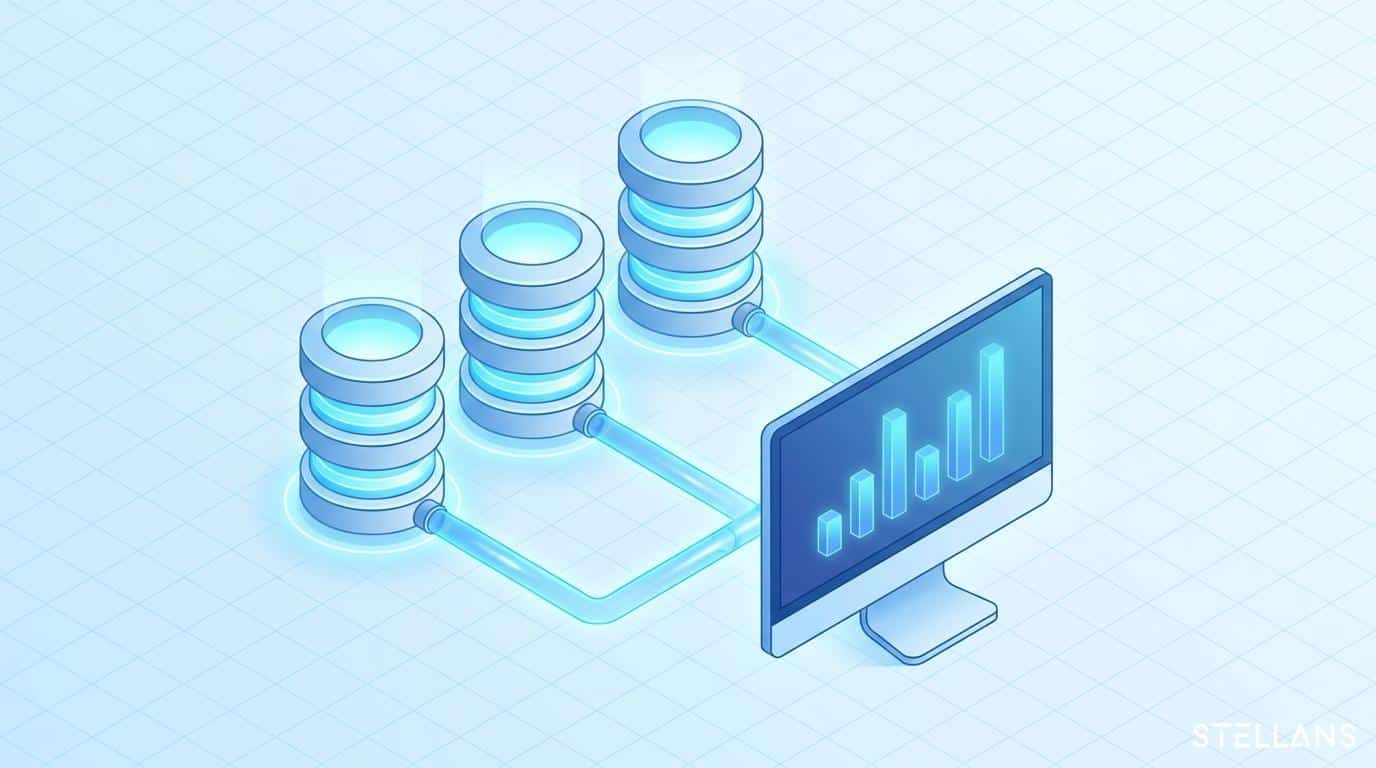
Transforming your business requires a highly systematic approach that tightly aligns technology choices with business goals.
1. Assess Your Data Sources & Business Goals
The fundamental first step is deeply identifying your core business objectives and primary key performance indicators. We start by auditing all existing data sources, spanning from your CRM to your complex ERP systems. Knowing where your information lives critically helps determine how to securely extract it. The aim is to map the technical requirements directly to your desired long-term business outcomes.
2. Build Resilient Data Pipelines and Cloud Warehouses
Data must flow without interruption to be truly useful. Setting up Change Data Capture (CDC) enables rapid, reliable data extraction without disturbing production databases. The data is then safely stored in a highly scalable cloud data warehouse like Snowflake. We always prioritize building resilient infrastructure over deploying superficial software visualization layers.
3. Deploy BI Tools for Intuitive Visualizations
Once the central warehouse is structured, it is time to deploy your chosen BI applications. This critical step involves creating dashboards that remain highly intuitive for non-technical users. The interface must clearly highlight essential business parameters and performance indicators to provide clarity. A clean and uncluttered visualization completely guarantees higher adoption rates among your management team.
4. Automate Weekly Reviews and KPI Tracking (WBR)
Automated tracking smoothly facilitates periodic business updates. Creating a streamlined automated WBR implementation keeps your top executives updated effortlessly. Your team will completely reclaim countless hours previously spent on manual data preparation. They can immediately shift their primary focus to taking decisive actions based on accurate numbers.
Reporting Efficiency Matrix
| Reporting Method |
Data Preparation Time |
Analysis & Action Time |
| Manual KPI Tracking |
80% |
20% |
| Automated BI Strategy |
10% |
90% |
5. Continuously Monitor and Optimize via DataOps
A successful data architecture constantly evolves alongside your business. You must continuously monitor and tightly optimize your environment via focused DataOps and data pipelines. Proactive testing and version control practically ensure your vital metrics remain highly reliable over time. Sustained governance smoothly keeps the system fast and highly responsive as your company aggressively scales.
Modern BI Architecture Pipeline