Apache Iceberg: Unifying Data Lake vs Data Warehouse in modern stacks

17 minutes to read
Get free consultation


Enterprise data teams can now solve a persistent dilemma: choosing between cost-effective storage and governed compute. For years, architects had to balance these trade-offs. You gain the flexibility of low-cost repositories alongside the transactional reliability of structured compute. We frequently work with clients who have historically built duplicate data pipelines to satisfy both needs. Our goal is your growth. We achieve this by implementing modern open table formats that deliver the absolute best of both architectures.

By deploying Apache Iceberg, you gain the best of both worlds. This framework transforms your analytical systems into a well-oiled data machine. We will show you how to maximize your infrastructure by bringing strict governance, schema enforcement, and rapid query performance directly to your object storage.

Introduction: Data Lake vs Data Warehouse

To understand the value of modern table formats, we must first examine the historical divide in enterprise data architectures.

Traditional Differences and Challenges

Data lakes offer low-cost object storage for diverse, unstructured, and semi-structured files. They excel at scale, though they require additional layers to ensure transaction guarantees. Maintaining file integrity and read consistencies requires careful management when multiple users read and write simultaneously.

Data warehouses provide governed, high-performance structured SQL compute. They enforce strict schemas and handle concurrent transactions beautifully. Optimizing cost remains a key consideration for storing massive volumes of raw historical data inside a tightly coupled compute engine.

Bridging this strict separation resolves significant architectural challenges. To serve data scientists who need raw files and business analysts who need clean tables, companies build redundant systems. Moving identical data from sources to both environments creates duplicate data pipelines. Unifying the environment streamlines your budget for both ingestion and storage. Most importantly, unifying the data flow ensures consistent metrics and promotes vendor flexibility.

Apache Iceberg: The Open Table Format Revolution

Modern stacks require a unified approach. Open table formats solve the historical divide by decoupling compute from storage while maintaining warehouse-level reliability.

What is Apache Iceberg?

Apache Iceberg is an open-source table format for huge analytic datasets. Think of Iceberg as the traffic control system for your data highway. It sits directly above the raw files in your object storage. It tracks exactly which files belong to which table at any given moment. Iceberg uses a rigorous metadata tree to define a table, optimizing performance beyond traditional directory structures.

How Iceberg Bridges Data Lakes and Warehouses

Iceberg bridges the gap by acting as a universal translation layer. It allows varied compute engines to interact with object storage as if they were interacting with a traditional relational database. We help enterprise architects implement this layer to unify their lakehouse data operations. When you use Iceberg, a data warehouse engine can run complex SQL joins directly against your lake storage in its original, unified format.

Key Features: Snapshot Isolation, Schema, and Partition Evolution

The true power of this format lies in its operational flexibility.

Architectural Overview

To fully leverage a lakehouse architecture, you need a clear blueprint of how the components interact.

Engines, Catalogs, Metadata Layer, and Object Storage

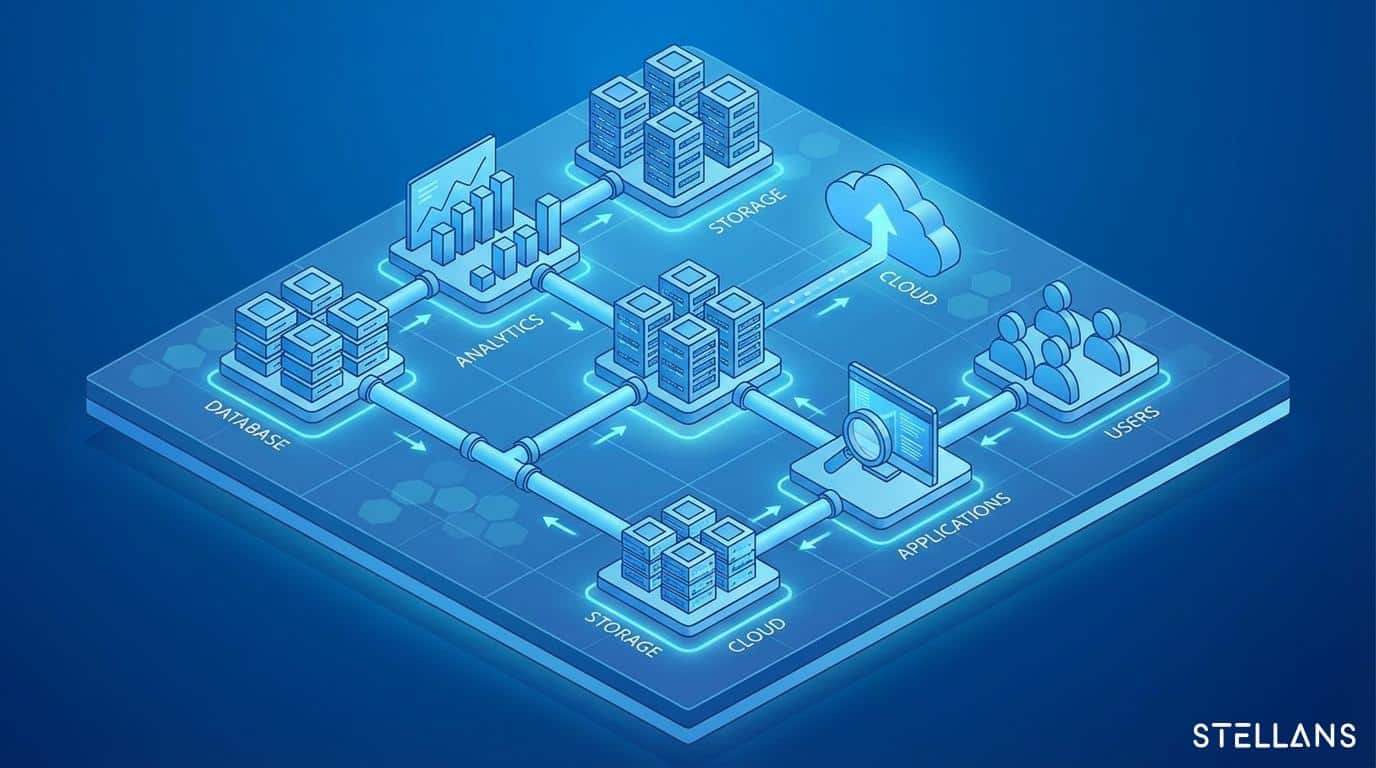
A modern data platform consists of four distinct layers working in harmony:

  1. Query Engines: Tools like Snowflake, Trino, or Apache Spark that execute the compute.
  2. Catalog: The central registry that tracks the current state of every table.
  3. Metadata Layer: A hierarchy of JSON and Avro files detailing snapshots, manifests, and file statistics.
  4. Object Storage: The physical location (like Amazon S3 or Google Cloud Storage) holding the raw Parquet data files.

Query and Write Flows with Iceberg

When a user submits a query, the compute engine follows a precise and optimized path to scan object storage. First, the engine asks the catalog for the latest table snapshot. The catalog returns a metadata file pointer. The engine reads this metadata to find a manifest list. This list points to individual manifest files.

These manifest files store column-level statistics for the actual Parquet files. By evaluating these statistics, the engine skips irrelevant files entirely. This process dramatically accelerates Parquet queries. During write operations, the engine creates new Parquet files and generates a new metadata tree. It then performs an atomic swap in the catalog, making the new data instantly available to readers.

Parquet Schema Management in Iceberg, Delta, and Hudi

Enterprise data teams often ask us to compare the major open table formats. While Delta Lake, Apache Hudi, and Apache Iceberg all aim to unify the data lake vs data warehouse, they manage underlying Parquet schema evolution very differently. Parquet schema evolution represents a core technical challenge in modern data engineering.

Apache Iceberg Iceberg relies on unique, immutable field IDs. When you create a table, every column gets a specific ID. The Parquet files store data mapped to these IDs rather than column names. If you rename a column, Iceberg simply updates the mapping in the metadata layer. The field ID remains constant. If you drop a column and add a new one with the same name, the new column gets a new ID. This intelligent tracking secures accurate schema evolution and protects data integrity. Iceberg’s strict ID tracking delivers flawless schema evolution natively.

Delta Lake Delta Lake handles schema management through a transaction log consisting of JSON and Parquet files. It relies heavily on column names. When you evolve a schema in Delta, the system appends the schema change to the transaction log. While Delta supports schema enforcement and evolution, relying on names requires careful planning when dropping and recreating columns with identical names. Delta has introduced column mapping features to mimic Iceberg’s ID approach, delivering advanced functionality when configured properly.

Apache Hudi Hudi manages schema changes through its central timeline mechanism. It relies on Avro schemas for internal representation and translates them to Parquet during writing. Schema evolution in Hudi is robust and handles complex operations effectively with appropriate configuration. Hudi excels in streaming upserts, utilizing a specialized payload mechanism to maintain schema management alongside its impressive streaming capabilities.

For clients prioritizing vendor-agnostic architecture and complex historical data management, we consistently recommend Iceberg. Its field ID architecture fundamentally resolves the challenges of Parquet queries and creates highly resilient pipelines.

Scaling Reads and Writes Simultaneously

Enterprise platforms process millions of transactions daily. You must scale read and write transactions simultaneously to maintain peak performance. Iceberg solves this through Optimistic Concurrency Control (OCC).

Under OCC, multiple writers can operate on the same table at the same time. When a writer finishes its task, it attempts to commit its new snapshot to the catalog. The catalog checks if another writer has committed changes to the same files in the meantime. The commit succeeds instantly when operations align. The writer simply retries the commit based on the new current state when conflicts arise. This atomic commit mechanism guarantees that readers always encounter complete and verified files.

To maintain this performance at scale, enterprise architects implement routine metadata compaction. Frequent small writes create thousands of tiny Parquet and manifest files. Regular maintenance ensures these files remain optimized for query speed. We build automated maintenance routines for our clients. These routines run background jobs to compact small data files into larger ones and rewrite manifest files to optimize metadata pruning.

Another practical consideration is decoupling your ingestion streams from your analytical compute. By dedicating a specific engine cluster to handle heavy writes and a separate cluster for complex analytical reads, you maximize throughput. Both clusters utilize the exact same Iceberg catalog, ensuring absolute synchronization without resource contention.

Snowflake, Fivetran, and Iceberg Integration for Enterprise Data Platforms

Building a unified architecture requires the right combination of tools. We specialize in deploying integrated ecosystems that drive real business impact. A proven pattern involves using Fivetran for automated data ingestion, Iceberg for the storage layer, and Snowflake for high-performance compute.

Fivetran provides reliable, low-maintenance connectors that extract data from your operational databases and SaaS applications. You configure the pipeline to write directly to your cloud object storage using the Iceberg table format, bypassing the need to load data into a proprietary warehouse storage layer. Fivetran handles the continuous CDC (Change Data Capture) streams, automatically updating the Iceberg tables and maintaining schema consistency.

Once the data lands in Iceberg, Snowflake steps in. Snowflake offers native support for Iceberg tables. You configure Snowflake to connect to your external Iceberg catalog. Snowflake reads the Iceberg metadata and executes highly optimized SQL queries directly against your object storage.

This integration delivers massive cost savings. You save significantly on Snowflake storage fees for raw historical data. You utilize Snowflake’s powerful compute engines strictly for generating business value. Our clients report significantly faster time-to-insight post-implementation. If you want to streamline your ingestion and compute architecture, explore our specific data integration expertise with Fivetran and Snowflake.

Addressing Vendor Lock-in, Duplicate Pipelines, and Slow Parquet Queries

The combination of open table formats and decoupled compute engines directly addresses the most severe audience pain points.

Eliminating Vendor Lock-in Iceberg keeps your data in your own cloud storage, empowering you to switch vendors without massive or expensive migration projects. Your data remains fully independent. If you want to switch from Snowflake to Trino for a specific workload, you simply point the new engine at your existing Iceberg catalog. You retain total ownership of your data infrastructure.

Stopping Duplicate Data Pipelines Iceberg allows organizations to consolidate the pipeline feeding the data lake and the warehouse into a single, efficient stream. We frequently work with clients who want to simplify their architecture by eliminating multiple pipelines for the same source data. By standardizing on Iceberg, you ingest data exactly once. Fivetran lands the data in Iceberg. Data scientists read that same Iceberg table using Spark. Business analysts query that exact same table using Snowflake. A single pipeline serves the entire enterprise.

Fixing Slow Parquet Queries Iceberg’s metadata layer contains precise minimum and maximum value statistics for every column in every file, solving the traditional speed challenges of external tables. When you query a specific date range, the engine reads the metadata first. It instantly ignores all Parquet files outside that range. This aggressive file pruning turns broad data lake scans into lightning-fast, warehouse-like queries.

Emerging Trends: Iceberg v3 Features and REST Catalogs

The Apache Iceberg ecosystem evolves rapidly. Enterprise architects stay informed about emerging trends to future-proof their platforms.

The introduction of the REST Catalog specification represents a massive shift. Historically, organizations used Hive Metastore or cloud-specific catalogs like AWS Glue. The REST Catalog standardizes how engines communicate with the metadata layer over HTTP. Solutions like the Apache Polaris REST catalog provide a universal, open-source registry that works seamlessly across all major compute engines. This guarantees true interoperability.

Additionally, Iceberg v3 specifications introduce advanced deletion vectors. The system efficiently writes a small bitmap file tracking the deleted row, accelerating operations without rewriting an entire Parquet file. During read operations, the engine applies this bitmap dynamically. This innovation dramatically speeds up streaming upserts and GDPR compliance requests.

Practical Implementation Checklist for Enterprise Architects

Transitioning to a unified lakehouse architecture allows for meticulous planning and robust results. We guide our clients through a rigorous implementation framework. Use this checklist to begin your journey:

Conclusion: Unified Architectures with Apache Iceberg and Stellans

You can achieve both cost-effective storage and dependable compute reliability. Apache Iceberg fundamentally changes how organizations manage enterprise data. By unifying the data lake vs data warehouse, you gain vendor flexibility, streamline your architecture, and deliver faster insights to your business stakeholders.

Building this architecture enables scalable systems that fuel growth and innovation. Partner with us to maximize your data potential and optimize your resources by eliminating duplicate pipelines. Explore our full range of engineering services today.
Frequently Asked Questions

What is the difference between a data lake vs data warehouse? Data lakes offer low-cost object storage for diverse data, while data warehouses provide governed, high-performance structured SQL compute. Apache Iceberg unifies them by bringing warehouse-like transaction capabilities directly to data lake storage.

How does Apache Iceberg unify data lake and data warehouse architectures? Iceberg acts as an open table format. It sits above Parquet files in your data lake and provides snapshot isolation, metadata pruning, and schema evolution, allowing engines like Snowflake to query the lake as if it were a warehouse.

Why should I choose Iceberg over Delta Lake or Hudi? Iceberg excels in vendor-agnostic environments. Its unique field ID system for Parquet schema evolution ensures strict consistency, protecting data integrity during complex column alterations and empowering you with complete architectural freedom.

Can multiple engines write to an Iceberg table at the same time? Yes. Iceberg uses Optimistic Concurrency Control to manage simultaneous writes. The central catalog coordinates atomic commits, ensuring that conflicting writes are safely retried and readers only ever see complete, consistent data snapshots.

Reference Links

Article By:

https://stellans.io/wp-content/uploads/2026/01/1723232006354-1.jpg
Roman Sterjanov

Data Analyst

Related Posts

    Get a Free Data Audit

    * You can attach up to 3 files, each up to 3MB, in doc, docx, pdf, ppt, or pptx format.
    This site is protected by reCAPTCHA and the Google Privacy Policy and Terms of Service apply.