Every attribution model reveals unique truths about customer behavior. Different business models benefit immensely from applying their specific analytical lenses. We help clients test multiple frameworks against their historical data. Exploring various methodologies reveals hidden performance trends within specific channels. Below is an overview of the primary frameworks utilized today.
| Model Type |
Pros & Cons |
Best Used For |
| Linear |
Pros: Simple, honors all touches.
Cons: Overvalues low-impact touches. |
Long B2B nurturing cycles requiring equal touchpoint valuation. |
| Time-Decay |
Pros: Rewards closing channels.
Cons: Undervalues top-of-funnel awareness. |
Short promotional campaigns with rapid buying cycles. |
| U-Shaped |
Pros: Highlights acquisition and conversion.
Cons: Ignores the middle engagement. |
Highly aggressive lead generation marketing strategies. |
| Data-Driven |
Pros: Algorithmic, highly accurate.
Cons: Requires heavy data volumes. |
Enterprises with heavy traffic and strong data engineering teams. |
Linear Attribution
Linear attribution flattens the complexity of the customer journey. It distributes financial credit completely evenly across every recorded touchpoint. If a customer interacts with four ads before purchasing, each ad receives exactly twenty-five percent of the value.
This model excels at simplicity. It acknowledges that every marketing effort contributes to the final goal. It evenly values all steps, though specialized models better highlight high-impact pivot points. A routine retargeting banner gets the exact same weight as a deep, two-hour webinar. We recommend this model only for organizations with very uniform, relationship-based engagement cycles.
Time-Decay Attribution
Time-decay attribution applies a strict recency effect. It utilizes an exponential mathematical decay function. Touchpoints occurring closer to the actual conversion event receive significantly more credit. A search click on the final day earns a high reward. A blog post read three weeks prior receives a tiny fraction of the final value.
This framework actively favors bottom-of-the-funnel tactics. It operates effectively for companies running flash sales or limited-time promotional events. The model logically assumes that recent interactions heavily drove the final purchase decision. Other models excel for high-ticket items requiring extensive preliminary research.
U-Shaped (Position-Based)
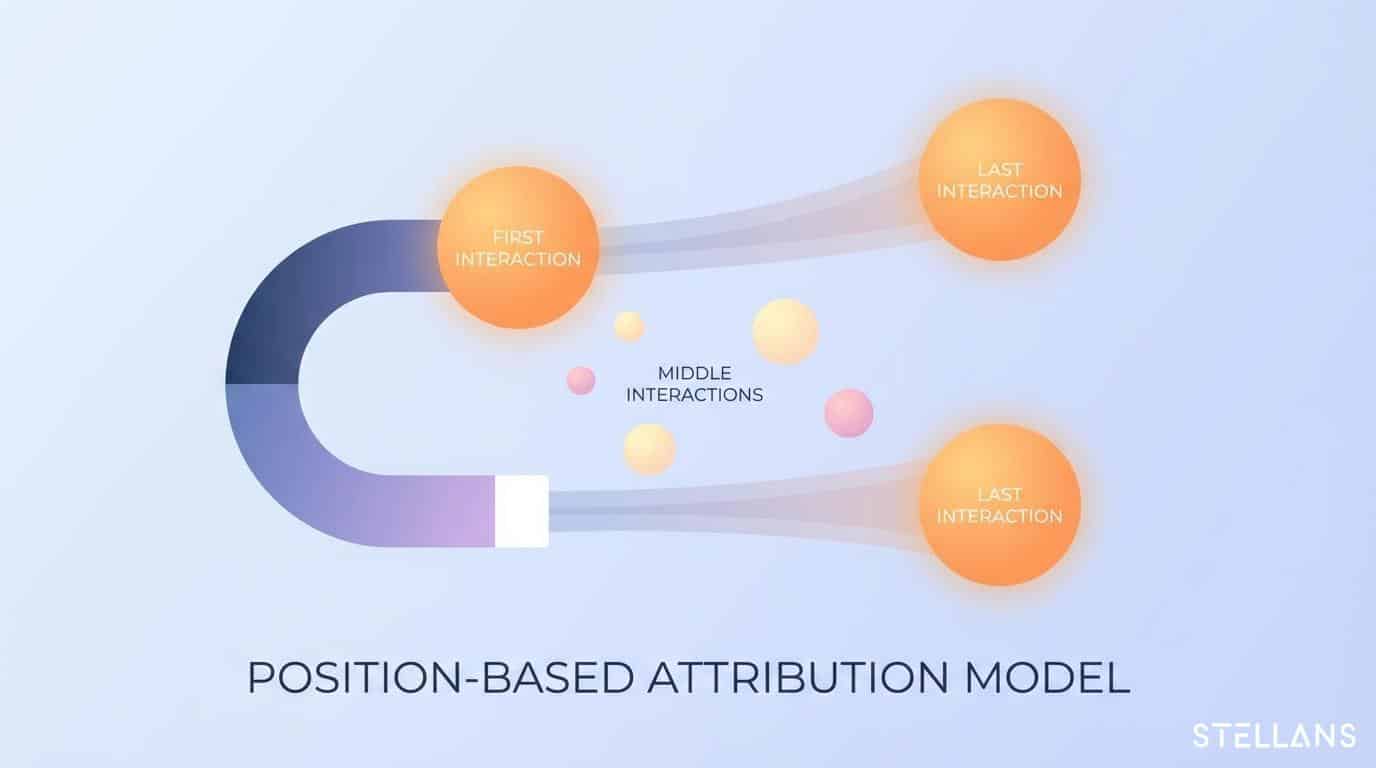
U-Shaped attribution recognizes the absolute importance of the extreme ends of the funnel. It typically utilizes a strict 40-20-40 percentage split. The very first interaction gets forty percent of the resulting credit. The final converting interaction also gets forty percent. All remaining middle interactions share the leftover twenty percent equally.
This position-based logic rewards the “opener” and the “closer” channels. We find this highly effective for organizations prioritizing new user acquisition alongside rapid checkout conversion. The model explicitly acknowledges that capturing attention and securing payment are the most critical marketing tasks.
Data-Driven Attribution
Data-driven attribution uncovers the algorithmic truth hidden within your specific historical data by embracing complete flexibility over fixed rule sets. Most modern mathematical approaches utilize either Markov chain methodologies or advanced Shapley value concepts.
Transition probability matrices power the Markov chain approach. The system calculates the specific “removal effect” of a channel. It asks a theoretical question: if we completely remove social media from our ecosystem, how drastically do conversions drop? Shapley values pull from cooperative game theory. They calculate the precise marginal contribution of a channel as it joins an ongoing customer sequence. Data-driven methods provide the most accurate budget allocation available today.