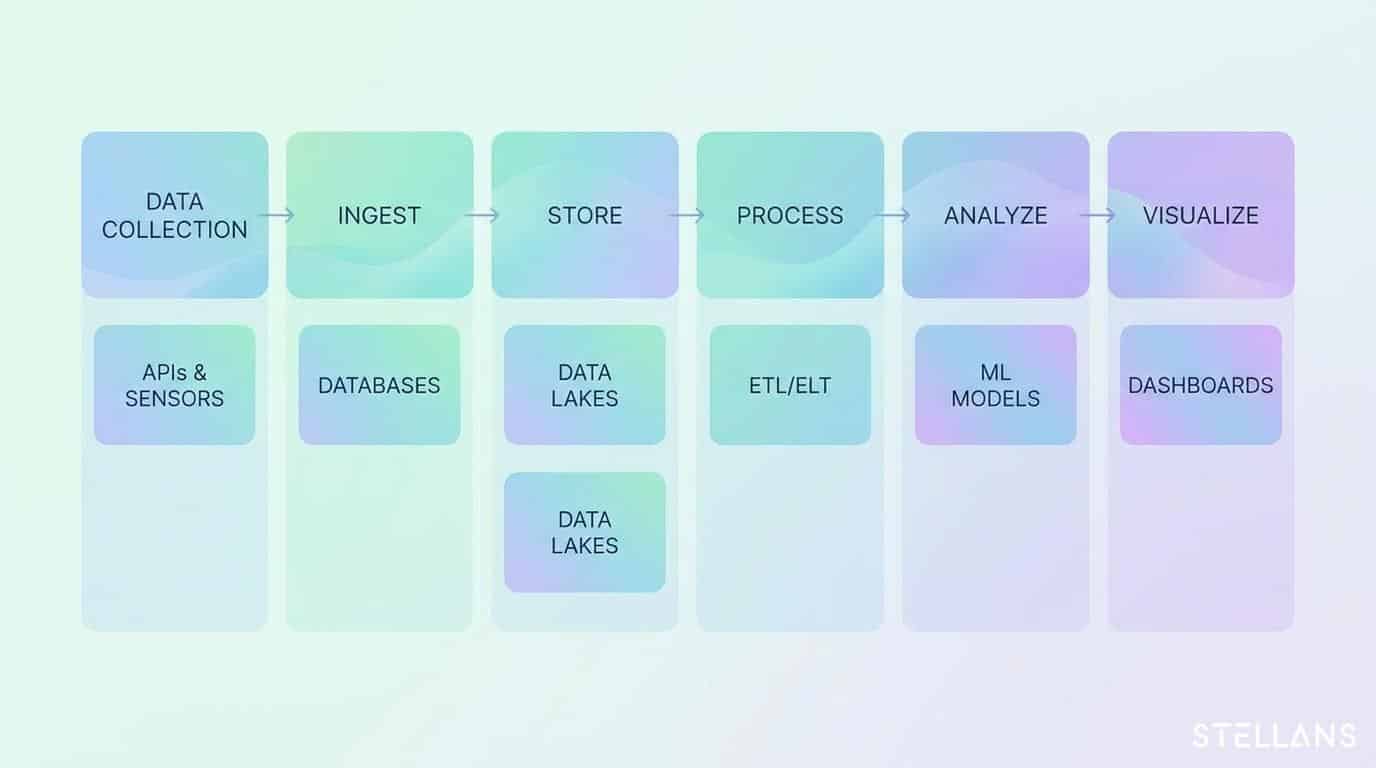
Building a successful data team requires precise role alignment. Each position owns a specific part of the data lifecycle. We detail the four essential roles below.
Data Analyst
Data Analysts focus heavily on consumer-facing insights. They answer specific business questions using structured data. This role requires strong communication skills and business acumen. Analysts translate complex trends into actionable strategies.
Their primary tools include SQL, Python, and visualization platforms. They spend most of their time querying data and building charts. A strong Data Analyst spots anomalies before they impact revenue. They bridge the gap between technical data and business strategy.
BI Developer
BI Developers focus on dashboard delivery and scalable reporting. They design the semantic layer for the organization. This layer ensures all business definitions remain consistent. BI Developers build the interactive tools that executives use daily.
They prioritize performance, usability, and data accessibility. A BI Developer understands the difference between BI and business analytics. They maintain the standardized logic that prevents conflicting KPIs. Their work ensures everyone looks at the exact same numbers.
Analytics Engineer
Analytics Engineers focus on transforming raw data into clean datasets. They build production-quality analytical foundations. This role sits between data engineering and data analysis. Analytics Engineers test logic and ensure data observability.
They rely heavily on tools like dbt (data build tool). They apply software engineering best practices to data models. An Analytics Engineer ensures only pristine data reaches the dashboards. They are the guardians of data quality and reliability.
Data Scientist
Data Scientists focus on predictive modeling and causal inference. They solve complex optimization problems for the business. This role requires advanced knowledge of statistics and Machine Learning. They use R or Python to uncover hidden patterns.
A Data Scientist focuses best on advanced modeling rather than building basic dashboards. They deliver the most value dedicating time to complex algorithms instead of cleaning raw data. Businesses achieve optimal results hiring this role after establishing a solid data foundation. Their models require highly reliable, structured inputs to function properly.