How to Implement Machine Learning in Your Business: A 5-Step Guide

9 minutes to read
Get free consultation

Introduction

Machine learning (ML) has graduated from the realm of academic R&D labs and hypothetical discussions to become a fundamental baseline for competitive business strategy. The focus is now on how effectively you can transition from “AI interest” to actual machine learning implementation, rather than if you should leverage artificial intelligence.

Achieving specific, value-generating ML requires navigating complexity. A staggering number of AI initiatives (some sources cite up to 85%) fail to move past the Proof of Concept (PoC) stage. They linger in “pilot purgatory” usually because the strategy connecting the code to the business outcomes is missing, not because the algorithms are flawed.

At Stellans, we believe success comes from having the smartest strategy rather than just the smartest algorithm. We work with you to turn the hype into a well-oiled machine that drives decision-making and efficiency. Whether you are a CTO looking to optimize supply chains or a CDO aiming to personalize customer experiences, the principles of deployment remain the same.

This guide acts as your strategic roadmap. We will walk you through how to implement machine learning by treating it as a disciplined product development cycle rather than a science experiment.

Why Most ML Projects Fail (And How Yours Won't)

Before diving into the “how-to,” it is critical to understand the pitfalls that derail most initiatives. Understanding these failure modes is the first step in ensuring your machine learning business case is solid.

The “Science Project” Trap

Treating ML as a product rather than a research endeavor is essential for success. In failed scenarios, data scientists are often hired and told to “find insights” in the data without a clear business problem to solve. They might build a mathematically perfect model that predicts churn with 99% accuracy, but if that model isn’t integrated into the CRM where the sales team lives, it provides zero business value.

Successful implementation requires a product mindset. This means defining the user, the utility, and the success metrics before a single line of Python is written.

The Data Silo Problem

Organizations often underestimate the state of their data infrastructure. You might have petabytes of customer data, but if it is fragmented across legacy ERPs, marketing automation tools, and local spreadsheets, it is unusable for machine learning. AI implementation requires unified, clean, and accessible data. A robust data engineering foundation ensures your ML models receive the fuel they need to function.

Step 1: Identify the Strategic Business Problem

Focusing entirely on your business pain points is the first step in learning how to implement machine learning effectively. The technology should always be the servant of the strategy, not the master.

Aligning with KPIs

Identify areas in your business where decisions are currently made based on gut feeling or static rules, and where those decisions have a high cost of error. Machine learning thrives in environments requiring prediction, classification, or optimization at scale.

We recommend categorizing potential use cases into three buckets:

  1. Revenue Growth: Can we cross-sell more effectively? (e.g., Recommender Engines)
  2. Cost Reduction: Can we automate manual document processing?
  3. Risk Mitigation: Can we detect fraud earlier?

Building the Business Case

To secure stakeholder buy-in, you must translate technical capabilities into financial projections. A strong machine learning business case articulates the ROI clearly.

How to Calculate Projected ROI: Estimate the gain by calculating the cost of current inefficiency.

Step 2: Assess Data and Infrastructure Readiness

Once the problem is defined, reality sets in. Do you have the data to solve it? The phrase “garbage in, garbage out” is the oldest cliché in data science because it is universally true.

Conducting a Data Audit

You need to audit your potential data sources for three key attributes:

  1. Volume: Do you have enough historical data to train a model? Neural networks need massive datasets, while linear regression might need less.
  2. Velocity: How fast is new data generated? Does your model need real-time streaming data, or is a nightly batch process sufficient?
  3. Veracity: Is the data accurate? Are there missing fields, duplicates, or inconsistent formats?

This is often where we step in with our Governance services to ensure that the data you are using is compliant, secure, and accurate.

Buy vs. Build: Choosing Your Tech Stack

Building a custom model from scratch is not always necessary.

For many of our clients, we recommend a hybrid approach: buy what is commodity, build what is a competitive advantage. We leverage our Engineering expertise to help you build the infrastructure that supports either path.

Step 3: Develop and Validate the Model (The Agile Way)

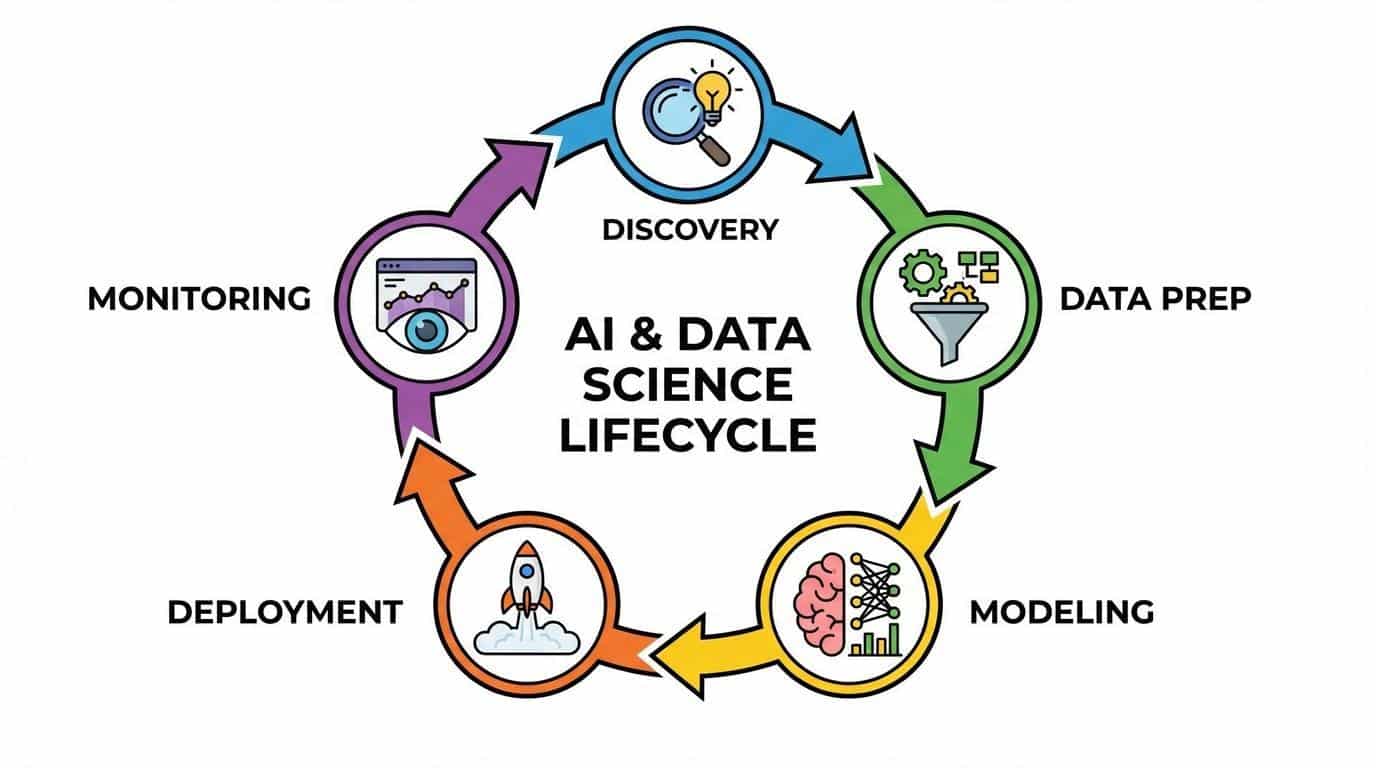
With a strategy in place and data secured, the actual modeling begins. We encourage starting with an Agile approach rather than aiming for immediate perfection.

Feature Engineering & Selection

Data in its raw form is rarely ready for a model. Feature engineering is the art of transforming raw data into inputs that a machine can understand and learn from. For example, a timestamp reading “2023-10-27 14:00:00” might be converted into features like “Day of Week: Friday,” “Hour: 14,” and “Is_Holiday: No.”

This step often yields the highest ROI in model performance. It requires deep domain knowledge, which is why collaboration between your subject matter experts and data scientists is non-negotiable.

Proof of Concept (PoC) vs. Prototype

There is a distinct difference between a PoC and a Prototype, and confusing them causes delays.

The “Human-in-the-Loop” Necessity

Initially, ML models often make mistakes. Implementing a “human-in-the-loop” workflow allows your team to review low-confidence predictions. This does two things: it mitigates risk by preventing bad automated decisions, and it creates a labeled dataset to retrain and improve the model. This is critical for machine learning strategy in high-stakes industries like healthcare or finance.

Step 4: Deploy with MLOps and Integration

Deployment converts potential energy into kinetic energy, solving the “Last Mile” problem. A model sitting on a data scientist’s laptop is potential energy.

Why You Need MLOps

MLOps (Machine Learning Operations) applies DevOps principles to data science. It automates the pipeline from code to deployment. MLOps ensures retraining is efficient and automated, preventing the manual, error-prone nightmare of maintaining models. Key components include:

Integration with Existing Workflows

Your ML output needs to surface where decisions happen.

This integration phase is where technical debt often accumulates. We focus on clean API structures and scalable architecture to ensure your specific ML solution doesn’t slow down your core applications.

Step 5: Monitor, Optimize, and Scale

Launch day is just Day 1. ML models degrade over time as the world changes, unlike traditional software code that remains static until edited. This is known as model drift.

Monitoring for Model Drift

There are two main types of drift you must monitor:

  1. Data Drift: The input data changes. For example, if you trained a pricing model on 2019 data, the economic shifts of 2020-2023 would make that data irrelevant. The distribution of the input variables has shifted.
  2. Concept Drift: The relationship between variables changes. For instance, customer purchasing behavior might change fundamentally due to a new competitor entering the market.

Creating a Feedback Loop

You need a system to capture the actual outcomes vs. the predicted outcomes. If the model predicted a customer would buy, and they didn’t, that negative result is valuable data. It should be fed back into the training pipeline to make the next version of the model smarter. This cycle is what creates a sustainable machine learning strategy.

Common Challenges in ML Implementation

Even with a perfect plan, hurdles will arise. Being aware of common challenges in ml implementation allows you to mitigate them proactively.

We frequently see these challenges discussed in broader operational contexts, such as McKinsey’s State of AI Report, which highlights the growing need for risk management in AI adoption. Furthermore, navigating the cultural shift toward data-driven decision-making is a frequent topic in the Harvard Business Review, emphasizing that technology is only half the battle.

Conclusion & Next Steps

Learning how to implement machine learning is a journey of continuous improvement, not a destination. It requires a shift from intuition-based management to evidence-based automation. By following these five steps—identifying the business value, securing the data foundation, iterating fast, deploying via MLOps, and rigorously monitoring—you move away from “innovation theater” and toward tangible ROI.

Your data is telling a story. The question is, are you listening?

At Stellans, we empower your organization to build the future. We don’t just write code; we build business capability.

Ready to build your roadmap? Let’s discuss your data potential. Get free consultation

Frequently Asked Questions

How long does it take to implement machine learning? A typical pilot or Proof of Concept (PoC) can take 4 to 8 weeks, depending on data readiness. However, a full production deployment with integration into business workflows generally takes 3 to 6 months. It is an iterative process that speeds up as your infrastructure matures.

What is the cost of implementing ML in business? Costs vary significantly based on complexity. A simple forecasting model using pre-built APIs might cost a few thousand dollars in engineering time. A custom deep-learning solution requiring proprietary data engineering and custom architecture can range into six figures. We recommend starting with a high-impact, low-complexity use case to fund future innovation.

Do I need a large data science team to start? No. Starting with a “minimum viable team” is often more efficient. This typically consists of a data engineer (to clean data) and a machine learning engineer (to build/deploy). Many businesses opt to partner with a consultancy like Stellans to handle the heavy lifting while their internal team matures.

References

Article By:

https://stellans.io/wp-content/uploads/2026/01/leadership-2.jpg
Anton Malyshev

Co-founder

Related Posts

    Get a Free Data Audit

    * You can attach up to 3 files, each up to 3MB, in doc, docx, pdf, ppt, or pptx format.