A Beginner's Guide to Predictive Modeling for Business

12 minutes to read
Get free consultation

A Beginner's Guide to Predictive Modeling for Business

In 2026, securing a competitive edge requires looking beyond past data. Analyzing only what happened last quarter is like driving your business using the rearview mirror. The companies winning today accurately anticipate the future rather than just reporting on the past.

According to industry research, AI-enabled supply chain management has proven to improve inventory levels by up to 35% and reduce logistics costs by 15%. This is math, not magic. Specifically, it is predictive modeling.

For many business leaders, analysts, and marketing managers, “predictive modeling” often sounds like a black box reserved for PhD data scientists. In reality, it is a practical business tool that answers the most critical question in your boardroom: What is likely to happen next?

This guide demystifies predictive modeling, explains how it works without the jargon, and outlines the steps to build a strategy that turns raw data into future revenue.

What Is Predictive Modeling? (The Plain English Explanation)

At its core, predictive modeling is a mathematical process used to predict future events or outcomes by analyzing patterns in a given set of input data.

Think of it like a weather forecast for your business. Meteorologists predict the weather by analyzing decades of historical weather patterns (data) and current conditions (variables), using complex equations (algorithms) to calculate the probability of rain.

In business, the process is identical:

Descriptive vs. Predictive Analytics

Understanding where predictive modeling fits requires distinguishing it from traditional reporting:

Shifting from reactive to proactive helps you prevent fires before they start.

3 Ways Predictive Modeling Transforms Business

Implementing predictive modeling focuses on solving expensive business problems rather than just adopting AI. Here are three specific ways it drives value.

1. Smarter Forecasting & Demand Planning

Retailers and manufacturers can avoid the “Goldilocks” problem where holding too much inventory ties up cash and holding too little leads to missed sales.

Predictive modeling ingests thousands of variables, including seasonality, economic indicators, and even marketing spend, to generate highly accurate demand forecasts, whereas traditional forecasting often relies on manual spreadsheets and “gut feeling” adjustments. This precision allows businesses to optimize stock levels, reducing carrying costs and preventing stockouts.

2. Risk Analysis & Fraud Detection

In sectors like finance and insurance, risk is the primary cost driver. A predictive model can analyze thousands of transaction points in milliseconds to spot anomalies that a human analyst might miss.

For example, a credit card issuer uses predictive models to flag a transaction as “likely fraudulent” before the payment even processes. Similarly, banks use credit scoring models to predict the likelihood of a loan default, allowing them to price risk accurately and protect their bottom line.

3. Understanding Customer Behavior

Modern marketing utilizes precise targeting rather than “spray and pray” tactics. Predictive modeling allows for hyper-personalization by anticipating customer needs.

By analyzing past purchase behavior and engagement metrics, models can identify:

For a deeper dive into how we apply these metrics, you can explore our approach to Customer Lifetime Value.

Real-World Predictive Analytics Examples

How does this look in practice across different industries?

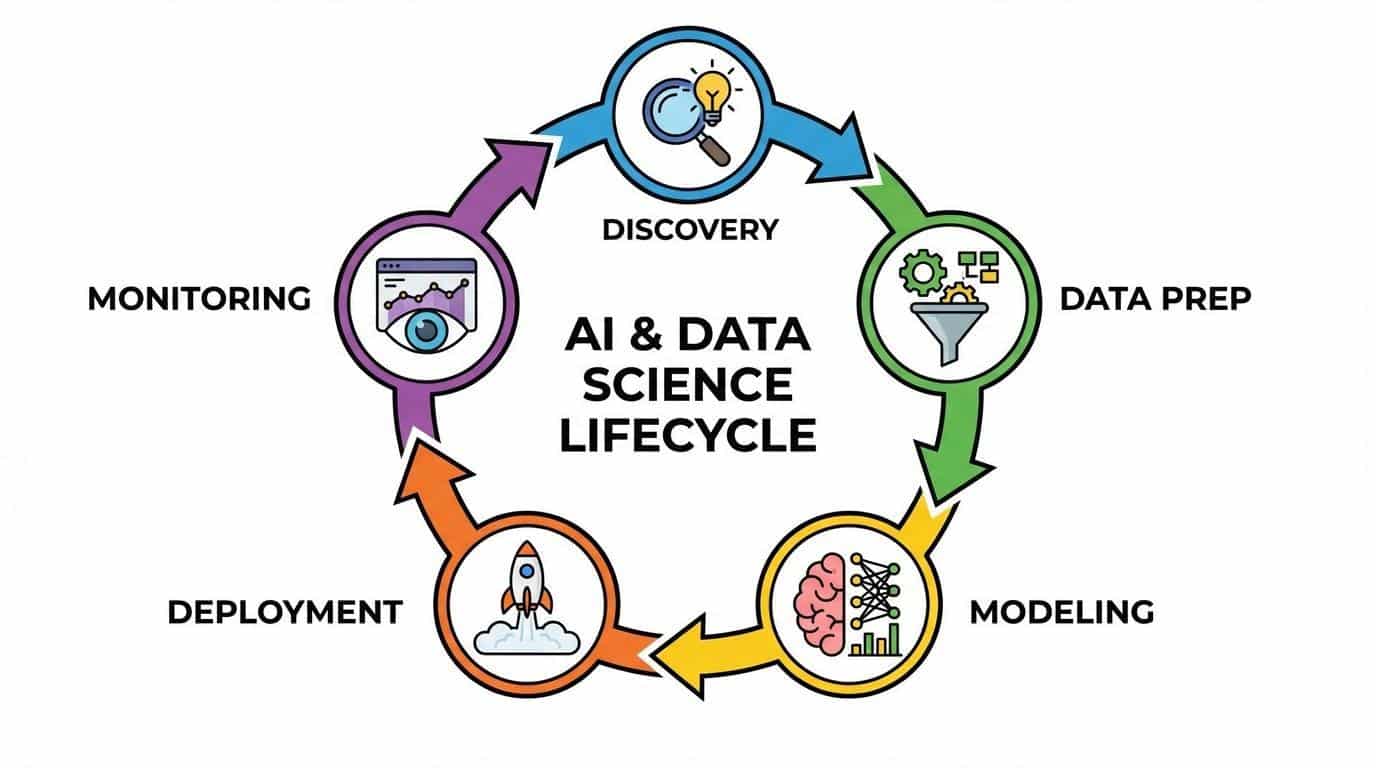
How to Build a Predictive Model: A 5-Step Overview

Building a reliable model is a rigorous process. While tools are getting better, the expertise required to select, train, and maintain a model is significant. This is where a partner like Stellans ensures you don’t just get a model, but a business solution.

Step 1: Define the Objective

Success comes from starting with a sharp, specific question rather than just data.

Step 2: Data Collection & Cleaning

Clean fuel ensures the engine runs smoothly. If the fuel is dirty, the engine will break. This step involves gathering data from disparate sources (CRMs, ERPs, and marketing platforms) and cleaning it. This includes fixing errors, handling missing values, and standardizing formats.

We often see that Data Engineering and preparation take up 70% of a project’s timeline, but it is the non-negotiable foundation of success.

Step 3: Model Selection & Training

A data scientist must choose the right statistical technique for their specific problem, as there is no “one ring to rule them all” in algorithms:

The model is then “trained” on historical data, learning the patterns that lead to specific outcomes.

Step 4: Deployment

Deploying the model into daily workflows ensures it delivers value, rather than sitting unused on a laptop. For a sales team, this might mean pushing a “Lead Score” directly into Salesforce so they know who to call first.

Step 5: Monitoring & Maintenance

Continuous monitoring ensures predictions remain accurate as models can degrade over time. This is known as Model Drift. Economic conditions change (like inflation in 2026), and consumer behaviors shift. A model trained on 2023 data may fail in 2026.

The 2026 Landscape: AI, Ethics, and Regulation

As we move deeper into the AI era, predictive modeling is evolving. It is no longer just about accuracy; it is about responsibility.

The Role of Generative AI

Generative AI enhances predictive modeling by simulating synthetic data to train models where real data is scarce, or interpreting complex model outputs into plain English summaries for executives.

Compliance (EU AI Act)

The EU AI Act, fully enforceable as of 2026, has changed the game. It categorizes AI systems by risk. High-risk models (like those used in hiring or credit scoring) face strict transparency requirements. Transparency is now required, replacing “black box” models where decisions are opaque. Explainability is now a legal and ethical requirement.

This regulatory landscape makes Data Governance more critical than ever. You need to know exactly where your data comes from and how your model uses it.

Common Challenges (and How Stellans Helps)

Despite the clear ROI, many organizations struggle to get started.

This is where we step in. At Stellans, we don’t just hand you a piece of software. We act as your strategic partner for Advanced Data Science. We handle the heavy lifting of pipeline creation, model training, and compliance, allowing you to focus on making decisions based on the insights we deliver.

Conclusion

Predictive modeling is the difference between guessing your future and shaping it. Whether you need to forecast demand to save on inventory costs or predict churn to retain your best customers, the math exists to give you the answer.

The barrier to entry has never been lower, but the cost of inaction has never been higher. Using your data to capture market share is far more effective than letting it sit idle.

Ready to stop guessing? Contact Stellans to discuss how we can build your first predictive model and turn your data into your most valuable asset.

Contact Us

Frequently Asked Questions

Q: What is the difference between predictive analytics and machine learning? A: Predictive analytics is the business goal (predicting an outcome), while machine learning is the technical method (algorithms) used to achieve that goal.

Q: Do I need Big Data to use predictive modeling? A: Not necessarily. Quality is more important than volume, so relevant and clean data is key. We can build effective models with small, high-quality datasets.

Q: How long does it take to build a predictive model? A: A simple pilot can take 4-6 weeks, while a complex, fully integrated enterprise solution may take 3-6 months, depending on data readiness.

Q: Is predictive modeling expensive? A: Costs vary, but the ROI is often rapid. For example, improving forecast accuracy by 20-50% can save millions in inventory costs, paying for the project many times over.

Article By:

https://stellans.io/wp-content/uploads/2026/01/leadership-1-1.png
David Ashirov

Co-founder, CTO

Related Posts

    Get a Free Data Audit

    * You can attach up to 3 files, each up to 3MB, in doc, docx, pdf, ppt, or pptx format.